Interlace Communications

Category: Marketing Strategies

  • May Is National Small Business Month: Why It Matters More Than You Think

    May Is National Small Business Month: Why It Matters More Than You Think

    You probably know a small business owner. Maybe you are one. Maybe you grew up watching your parents run one from the kitchen table while dinner got cold. Or maybe you became one yourself because somebody once told you your idea was worth trying and you believed them.

    May is National Small Business Month. It has been for decades. But this year it is a little different.

    The Backbone Nobody Talks About

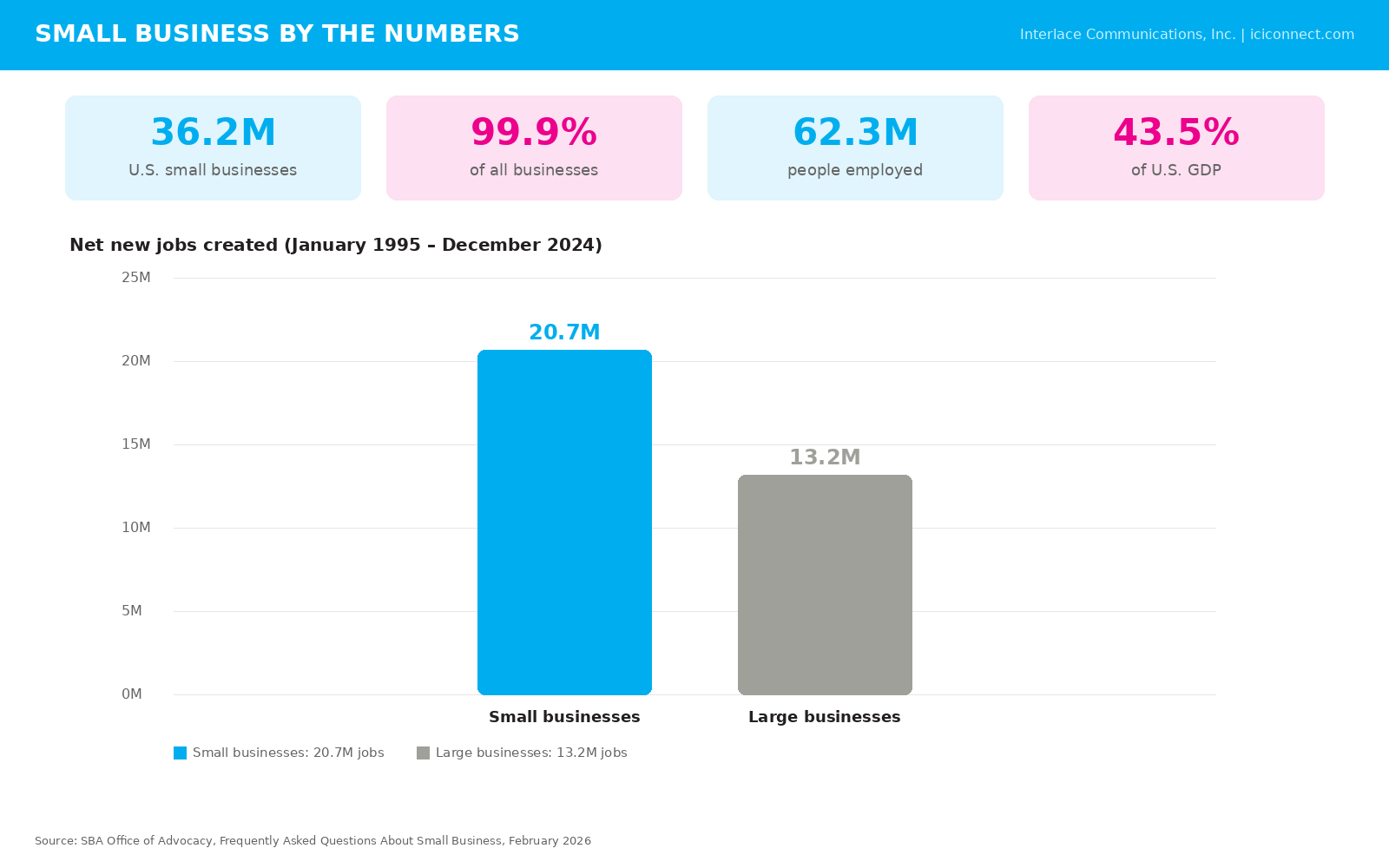
    Here is something that still catches people off guard. Small businesses account for 99.9% of all businesses in the United States. Not a typo. Nearly every business in this country is a small one. They produce 43.5% of the nation’s gross domestic product and over the last three decades they have created more than 20 million jobs. More than half the American workforce clocks in every morning at a small business.

    Those numbers are massive. But they do not tell the whole story.

    What the data misses is the contractor who answers the phone at 9 p.m. because a homeowner has a leak. The accountant who stays late in March so her clients can sleep at night. The print shop that donates flyers for the church fundraiser every single year without being asked. That is what a small business really looks like. It looks like people showing up for their neighbors.
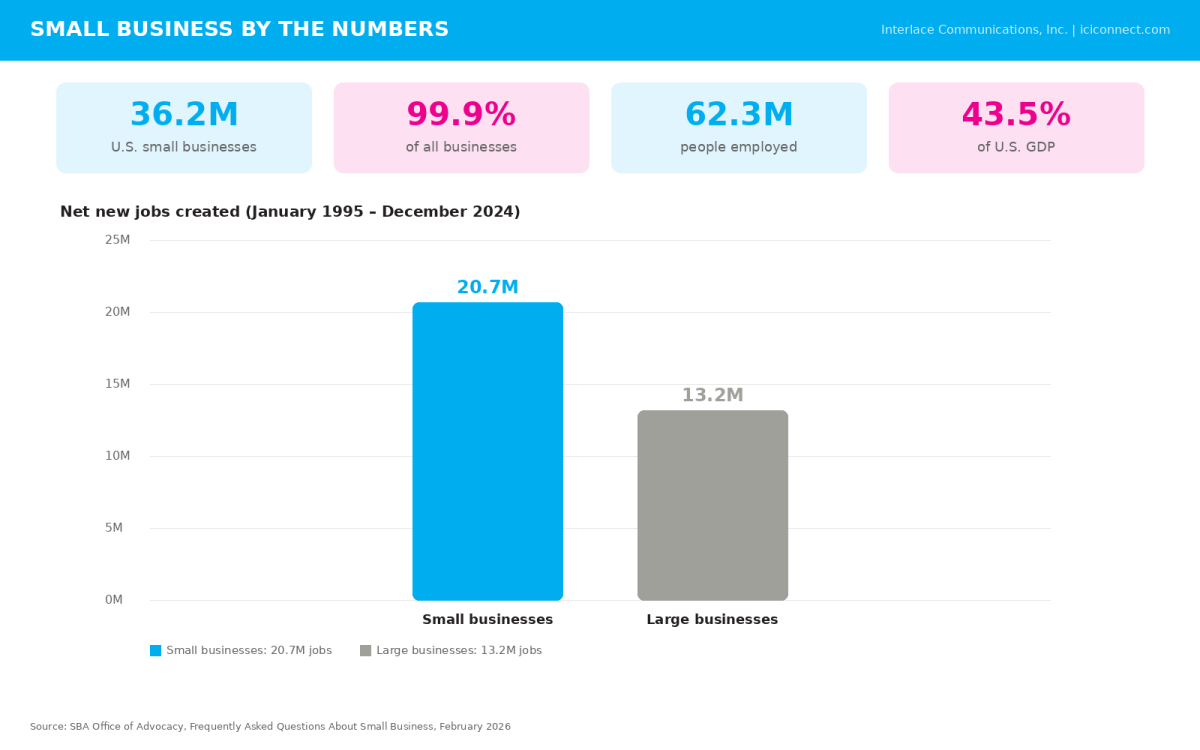
    Small Business by the Numbers: SBA Office of Advocacy, Frequently Asked Questions About Small Business, February 2026 (advocacy.sba.gov)

    This Week is the Big One

    National Small Business Week 2026 runs the first full week of May. The Small Business Administration hosts a free Virtual Summit with workshops on everything from digital marketing to scaling your operations. State or local business organizations often hold events that week or through the month to celebrate on a smaller scale. Check out your own local programs and attend events with your fellow small business owners.

    But honestly the celebration does not need to stop after one week. The entire month of May belongs to the businesses that keep our communities stitched together.

    What This Month Can Do for Your Business

    Take a breath and look at your own operation for a minute. When was the last time you read your own website the way a stranger would? Does it answer the questions people are actually asking before they call you? Are your blogs doing real work or are they just filling space?

    In 2026 the way people find businesses has changed. Search engines and AI tools are reading your content and deciding whether to recommend you. That is not a theory. That is happening right now. Businesses that publish clear and helpful content get discovered. Businesses that stay quiet get passed over. A strong website and a steady blog are not luxuries anymore. They are how you stay visible.

    And here is the thing most business owners forget. You do not need to overhaul everything at once. Start with one blog that answers a question your customers ask you all the time. Update your About page so it no longer sounds like a brochure from 2014. Small moves add up.
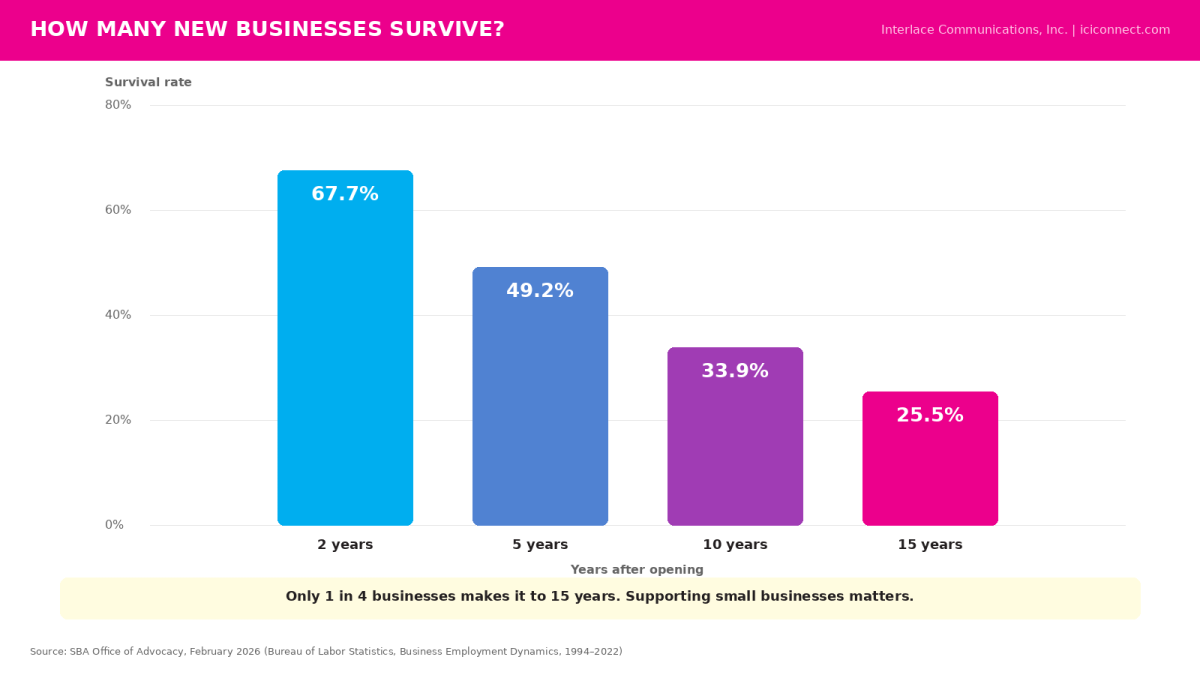
    Survival Rates: SBA Office of Advocacy, February 2026; Bureau of Labor Statistics, Business Employment Dynamics (1994–2022)

    How Everyone Else Can Help

    Not a business owner? You still have a role to play this month. Buy a gift card from a local shop. Leave a review for that restaurant you keep meaning to recommend. Share a post. Tell a friend. Show up at the farmers market this weekend and say hello to the people behind the tables. It costs nothing and it means everything to someone who bet their savings on a dream.

    Frequently Asked Questions About National Small Business Month

    What is National Small Business Month?

    Every May the United States sets aside the entire month to recognize and celebrate the contributions of small business owners. The tradition goes back decades. The U.S. Small Business Administration leads the effort by hosting events and highlighting entrepreneurs who make a real difference in their communities.

    It is time to acknowledge that the backbone of this country’s economy is not Wall Street or Silicon Valley. It is the local businesses on Main Street that hire our neighbors and sponsor our kids’ teams.

    What is National Small Business Week 2026?

    National Small Business Week is the centerpiece of the month. In 2026 it ran from May 3 through May 9. The SBA hosted a free Virtual Summit on May 5 and 6 packed with workshops on topics like digital marketing strategy and business growth. They also announce their annual small business award winners during the week. Whether you attended in person or tuned in online, the week is a solid opportunity to learn something new and connect with other business owners who understand exactly what you are going through.

    If you missed this year, put next year’s dates in your calendar to attend in 2027.

    How can I support small businesses in my community?

    This one is easier than most people think. Buy from a locally owned shop instead of ordering online when you can. Leave a Google review for a business you love. Share their social media posts. Recommend them to a friend. Purchase gift cards from local restaurants and service providers as birthday or holiday gifts. Attend a community event like a farmers market or a local fair where small businesses set up and sell. Every one of those actions puts real dollars and real visibility behind someone who poured their heart into building something from scratch.

    Why does my small business need a blog?

    Because in 2026 your blog is one of the most powerful marketing tools you have. A blog does more than keep your website looking current. It tells search engines and AI-powered search tools what your business knows and who it serves.

    When someone in your area types a question into Google or asks an AI assistant for a recommendation, your blog content is what those systems read to decide whether your business is a good match. Without it you are invisible to a growing number of potential customers. A well-written blog also builds trust with the people who do find you. It shows them you understand their problems before they ever pick up the phone. That kind of credibility is hard to buy with advertising alone.

    The businesses that blog consistently with clear and helpful content see more website traffic and more inquiries over time. It is not magic. It is marketing that works.
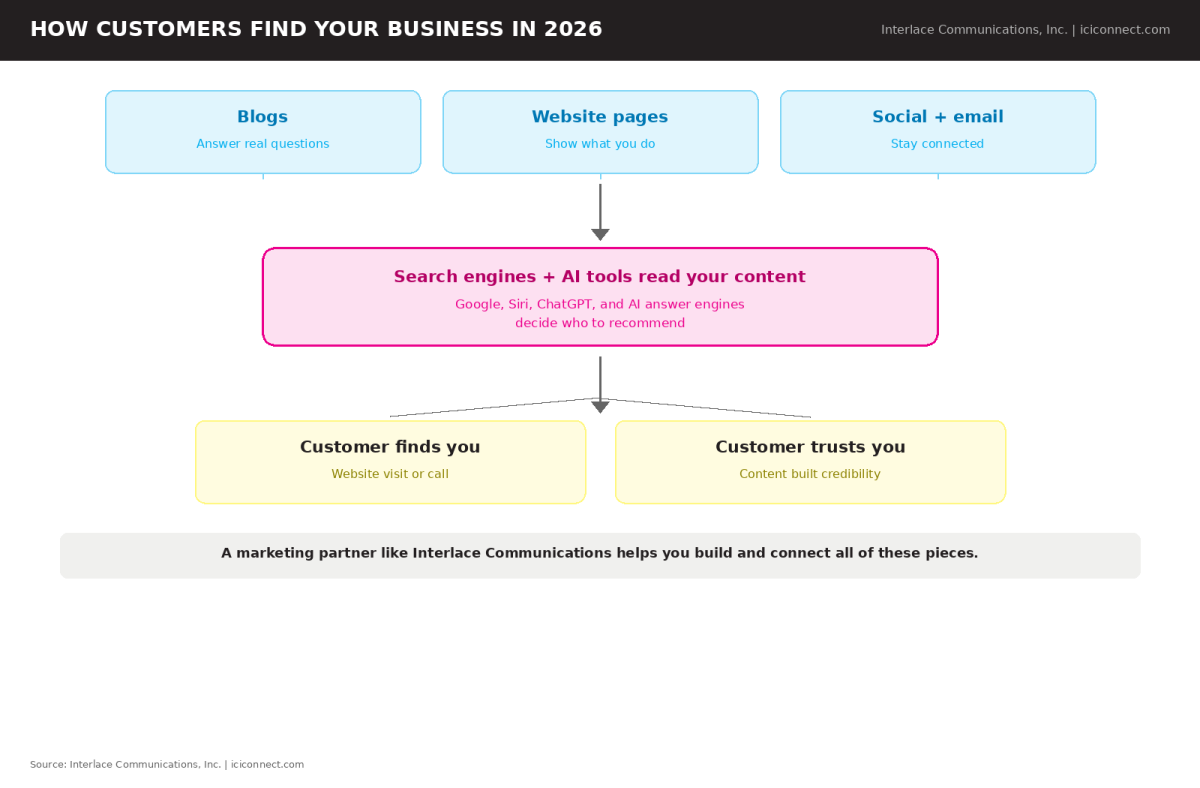
    How Customers Find Your Business in 2026: Interlace Communications, Inc. (original educational graphic)

    How do I make my small business easier to find online?

    Start with the basics. Your website needs to load quickly and look professional on a phone because that is where most people are searching. Your content needs to answer real questions that your ideal customers are asking. Search engine optimization helps your site rank higher on Google and AI-driven answer engines are now pulling directly from well-structured website content to recommend businesses in their results.

    Beyond your website, a consistent social media presence keeps your brand in front of people between searches. Email marketing helps you stay connected with customers who already know you. And do not underestimate commercial printing. Brochures, business cards and direct mail pieces still work especially when they match the same branding your audience sees online. The key is making sure all of these pieces work together instead of operating in silos.

    A full-service marketing partner, like Interlace Communications, can help you build that kind of connected strategy so nothing falls through the cracks.

    Small Shifts Lead to Real Results

    Every big brand started as a small one. Every household name began with someone who had no guarantee it would work. Supporting small businesses is not charity. It is an investment in the neighborhoods and families and communities that make a place feel like home.

    At Interlace Communications, we have spent more than 30 years helping small businesses across Pennsylvania and beyond get found and get remembered using:

    • Website design.
    • Blog management.
    • Search engine optimization.
    • Email marketing.
    • Social media marketing.
    • AI consulting and training.
    • Commercial printing.

    We do all of it because we believe in the people doing the work.

    Let’s talk about what’s possible for your business.

    Reach out to Interlace Communications at 484-709-6564 or visit our Help Desk.

  • Why Does My Content Get Ignored… Even When I’m Posting Consistently?

    Why Does My Content Get Ignored… Even When I’m Posting Consistently?

    If your content isn’t getting attention, it’s not because your message is wrong… it’s because attention has changed. Static posts are easier to scroll past, while motion-based content naturally pauses the eye. A simple shift to scroll stopping content can make the difference between being skipped… or being seen.


    You sit down.
    >You write the post.
    >You share something helpful… maybe even really good.

    And then…

    Nothing.

    A few likes. Maybe a comment. Mostly silence.

    So you wonder…
    “Is it me?”
    “Is it the message?”
    “Am I just not good at this?”

    But here’s the truth.

    It’s not you.

    It’s the way content is being seen… or more accurately, not seen.


    What We Saw in March… And Why It Matters Now

    In March, we focused on something most business owners feel but don’t always say out loud…

    Everything takes too long.

    Creating content. Building presentations. Trying to keep up.

    And once people saw a better way to do it, something clicked.

    Relief.
    Clarity.
    Momentum.

    But then came the next question…

    “Okay… this is faster now. But why isn’t it getting noticed?”

    That’s where things start to change.

    The Problem Isn’t Your Content… It’s Attention

    You’re not competing against bad content.

    You’re competing against everything.

    Every scroll, every distraction, every split-second decision someone makes while looking at their phone.

    And right now…

    Still images just don’t behave the way they used to.

    They don’t stop the scroll.

    They blend in.


    What Happens When Content Blends In

    This is the part that gets frustrating.

    You can be consistent.
    >You can be thoughtful.
    >You can even be doing everything “right.”

    And still…

    • Your posts get skipped
    • Your message doesn’t land
    • Your effort doesn’t turn into action

    Not because it’s wrong.

    Because it never got the chance to be see

    Ever Feel Like Your Posts Just Blend In?

    You share good content. You post regularly. And still… it barely gets noticed.

    It’s not because your message is wrong. It’s because still images don’t behave the way they used to.

    In this workshop, we’ll talk about why movement matters now… why attention pauses for just a few seconds… and how some posts quietly earn that pause while others disappear.

    No filming.
    >No editing skills.
    >No pressure to be on camera.

    Just a smarter way to help your content get seen without starting from scratch.

    Once you understand this shift, static posts won’t look the same again.


    Why Motion Changes Everything

    Static Content Motion-Based Content
    Easy to scroll past Pauses attention
    Blends into the feed Stands out naturally
    Lower engagement Higher interaction
    Often ignored Invites curiosity

    This isn’t about doing more.

    It’s about finally being seen.


    3 Reasons Your Content Isn’t Getting Noticed Anymore

    • The feed is faster than ever
      People react before they read
    • Still images don’t interrupt behavior
      They look like everything else
    • Attention is earned in seconds
      Not minutes… seconds


    A Note From Alyse

    “Most business owners don’t need more content… they need their content to actually be seen. Once you understand how attention works today, what you’re already creating starts working for you in a completely different way.”


    FAQ… Let’s Keep This Real

    Do I have to be on camera?
    No. You don’t need to film yourself to create motion.

    Is this hard to learn?
    Not at all. Once you see it, it makes sense quickly.

    Will this work for my business?
    Yes. Attention works the same way whether you’re a local service, nonprofit, or growing company.

    Here’s What to Do Next

    You don’t need to start over. You just need your content to get a fair shot at being seen.

    Workshop: Scroll Stopping Video Tricks
    📅 April 15, 2026
    🕓 4:00 PM (EST)
    👉 https://ici4u.com/ScrollStoppingVids

    And should you want help applying this to your business… not just learning it…

    Because when your content gets noticed… everything else starts to follow.

  • Why Does AI Feel So Overwhelming—and What Actually Makes It Useful for Small Businesses?

    Have you ever opened an article about AI, skimmed a few paragraphs, and closed the tab feeling more confused than when you started?

    That reaction is more common than most people admit—and it has nothing to do with intelligence, capability, or being “late to the game.”

    For many small and mid-sized business owners, AI doesn’t feel exciting. It feels noisy. Rushed. Slightly intimidating. The message often sounds like everyone else already understands it and you somehow missed the meeting where it was explained.

    Here’s the truth most conversations skip over: The problem isn’t AI. It’s the way AI has been introduced.

    AI feels overwhelming because small business owners are flooded with tools, advice, and pressure without context. What makes AI useful is clarity. When AI is introduced one purpose at a time, aligned with real workflows and supported by guidance, it becomes a practical business tool instead of a source of stress.

    Why AI Feels Overwhelming in the First Place

    Most businesses aren’t avoiding AI because they’re overwhelmed by fear of technology. They’re overwhelmed because the AI conversation has been built on urgency instead of understanding. Instead of being shown how AI fits into their day-to-day work, they’re told what they should already know.

    Usually it sounds like this: you’re told there are dozens of tools you need to try. You’re warned that not using AI means you’re falling behind. You hear big promises about automation, productivity, and growth—without any explanation of how this connects to your actual workload.

    Underneath all that noise is a quieter concern that rarely gets addressed: What happens if you choose the wrong tool? What if you invest time or money and don’t see results? What if you don’t use it “correctly” and feel foolish for even trying?

    That pause isn’t resistance. It’s discernment. And discernment is exactly what strong decision-makers rely on.

    What Actually Makes AI Useful for Small Businesses

    AI becomes useful when the noise stops.

    Not when you add another platform. Not when you chase the newest feature. But when the conversation slows down enough to ask one practical question: What do we actually need help with right now?

    That’s where practical AI for small business begins.

    Used thoughtfully, AI supports thinking instead of replacing it. It helps draft content, organize ideas, summarize information, outline plans, and reduce friction in everyday tasks. The value isn’t about doing more—it’s about making necessary work feel lighter and more manageable.

    Clarity, not urgency, is what allows AI to become useful.

    Three Reasons AI Feels Overwhelming (and What Fixes Them)

    1. Trying to learn everything at once
      AI works best when it’s applied to one clear task at a time.
    2. Collecting tools without a strategy
      One well-chosen AI tool used consistently delivers more value than juggling multiple platforms.
    3. Skipping guidance
      Clear goals and real-world examples matter far more than technical knowledge.

    This is where AI consulting services add real value—not by introducing complexity, but by removing it.

    AI Myths vs. Reality for Small Businesses

    What Creates Overwhelm What Actually Works
    You need to learn everything immediately You start with one practical use
    AI replaces people AI supports people
    More tools equal better results Simplicity produces better outcomes
    You need technical skills You need clarity and direction

    A Calm Guide in a Noisy Space

    Helping businesses adapt to change is not new for Interlace Communications. For decades, we’ve guided clients through major shifts—from print to digital, from websites to social media, and now to AI for business.

    Each transition has reinforced the same lesson: People don’t need hype. They need context.

    As Alyse Mitten, President and Founder of Interlace Communications, explains:

    “Confidence with AI doesn’t come from trying everything. It comes from choosing one tool, understanding why you’re using it, and applying it consistently. When people have clarity, the technology finally starts to feel useful.”

    That philosophy shapes how we approach AI workshops for business owners—one topic at a time, one tool at a time, always grounded in how real teams actually work.

    Why Workshops Matter More Than Tutorials

    Most AI content online falls into one of two extremes. It’s either too broad to be useful or too technical to feel approachable.

    A hands-on AI workshop creates something different. It creates space to ask questions, see real examples, and understand not just what a tool does—but why it matters for your business.

    Our AI Without the Overwhelm workshop is designed for leaders who want clarity and direction, not another trend to keep up with. The session focuses on practical understanding and a clear next step. Our workshop also includes the option to schedule a 30-minute follow-up session. That’s where insight turns into application and decisions turn into action.

    Frequently Asked Questions

    Is AI only useful for marketing?
    No. While using AI in marketing is common, many businesses start with writing, planning, and internal organization.

    Do I need experience with AI before attending a workshop?
    No experience is required. These workshops are built specifically for beginners and cautious adopters.

    Will AI change how my team works?
    AI should support your team, not disrupt it. The goal is smoother workflows—not replacement.

    Is this about tools or strategy?
    Strategy comes first. Tools are selected only after goals are clear.

    Your Next Step

    You don’t need to become an expert. You don’t need to move faster than you’re ready for. And you don’t need to figure this out on your own.

    AI becomes useful when it’s introduced with intention, guidance, and respect for how real businesses operate.

    Join us for AI Without the Overwhelm.
    Save your seat. Ask your questions. Then schedule a 30-minute session to apply what you’ve learned in a way that actually makes sense for your business.

  • Why Is Print Marketing Still Powerful in the Digital Age?

    Why Is Print Marketing Still Powerful in the Digital Age?

    Print marketing remains relevant in the digital age because it creates tangible connections with customers, boosts brand credibility, and complements digital strategies through integrated approaches like QR codes. Physical materials like brochures and business cards continue to drive engagement through their tangibility, memorability, and ability to reach audiences regardless of digital access.

    Can Print Really Thrive in Our Digital World?

    Today, I’m excited to explore a question that’s popping up more and more: Does print still matter in our increasingly digital lives? From my experience, the answer isn’t just yes—it’s absolutely!

    Let me share why combining the tactile charm of print with the dynamic power of digital creates a synergy that’s truly remarkable. I’ve seen firsthand, alongside clients and peers, how bridging these two worlds can make all the difference.

    The Tangible Power of Print

    Print materials offer a unique advantage: they’re tangible. Think about the feeling of handing someone a beautifully designed business card. It’s not just about exchanging information—it’s a physical representation of your professionalism, personality, and attention to detail.

    Imagine brochures displayed in offices or handed out at events. People interact with your content at their own pace—no screens or Wi-Fi required. It’s personal, memorable, and creates lasting impressions through touch, sight, and even smell. Yes, smell! Freshly printed materials can truly imprint your brand in someone’s memory.

    QR Codes: Bridging the Gap Between Print and Digital

    One of the most exciting tools I’ve introduced clients to lately is the humble QR code. These little squares have revolutionized print materials by instantly linking users to:

    – Websites and landing pages
    – Exclusive promotions
    – Engaging video content
    – Digital catalogs and portfolios
    – Social media profiles
    – Immediate contact details

    Picture handing someone your business card. With a quick scan, they don’t just get your contact information—they access your entire digital world. That’s powerful!

    Building Trust and Credibility

    Let’s talk about trust. Print inherently carries credibility. Investing in high-quality print materials signals to your audience that you’re established, reliable, and committed to excellence.

    Ever noticed how a thoughtfully crafted direct mail piece can catch your attention amid the clutter of emails? Clients frequently share how these tangible interactions help them stand out, creating genuine moments of connection and trust.

    Reaching Beyond Digital Boundaries

    Digital fatigue is real, and print provides a refreshing alternative. Here’s who especially benefits:

    – Older demographics comfortable with traditional media
    – Communities with limited digital connectivity
    – People experiencing screen fatigue
    – Professionals in environments restricting digital device usage

    Print ensures your message reaches everyone, everywhere.

    Integrating Print and Digital for Maximum Impact

    The secret isn’t choosing print or digital—it’s integrating both strategically. Here’s how savvy businesses are doing it:

    – Direct mail with QR codes leading to personalized digital experiences
    – Business cards connecting to online portfolios or demonstration videos
    – Catalogs linking directly to up-to-date digital inventory
    – In-store print signage encouraging digital interactions
    – Newsletters offering exclusive online content through QR codes

    Measuring Print’s Success

    One past challenge with print was tracking its effectiveness. Thankfully, those days are behind us! Using QR codes, dedicated landing pages, or unique contact numbers makes tracking interactions straightforward and insightful, helping you continuously refine and improve your strategies.

    Ready to Harness the Best of Both Worlds?

    At Interlace Communications, we help businesses combine print and digital strategies smoothly, boosting their impact with customers at every step. If this sounds interesting, let’s talk about creating clear, effective print marketing your audience will love.

    Print isn’t old-fashioned—it’s changing for the better. When paired with digital tools, incredible things happen!

  • 20 Hooks for Small Business Saturday (Updated for Post Pandemic)

    20 Hooks for Small Business Saturday (Updated for Post Pandemic)

    Revitalizing Small Business Saturday: 20 Modern Hooks for a New Era

    (Blog Updates: We’ve reimagined our “20 Hooks for Small Business Saturday” to cater to the evolving consumer landscape. This updated guide infuses traditional tactics with digital innovation, emphasizing safety, convenience, and community. We hope you will find our modernized strategies that are a blend of the best of both worlds, ensuring your Small Business Saturday is a hit in the post-pandemic marketplace.)

    As we navigate the new normal, Small Business Saturday remains a beacon for local enterprises, symbolizing resilience and community spirit. With the landscape of retail forever changed, it’s crucial to adapt and innovate. Here are 20 refreshed strategies to make Small Business Saturday a triumph in the post-pandemic world.

    Digital Ideas

    1. Digital Thanksgiving Greetings: In the spirit of gratitude, craft heartfelt digital cards to thank your patrons. Embed a mystery discount code that piques interest and drives online traffic. This gesture not only shows appreciation but also integrates a sense of excitement and exclusivity, encouraging customers to engage with your brand online and discover their special offer, leading to increased anticipation and potential sales on Small Business Saturday.

    2. Virtual Scavenger Hunt: Engage customers with a virtual scavenger hunt that cleverly incorporates your product line into puzzles and riddles. Participants can navigate through your website, uncovering clues and learning about your offerings. This interactive journey culminates in discounts or special offers, rewarding their digital adventure and fostering a fun, memorable shopping experience that highlights your brand’s creativity and customer engagement.

    3. Collaborative Online Events: Capitalize on community strength by joining forces with neighboring businesses to host a virtual Small Business Saturday event. This collective effort can amplify your reach, share marketing resources, and create a comprehensive online shopping experience that celebrates the diversity and uniqueness of your local business community.

    4. Late-Night Virtual Sales: Replicate the thrill of midnight sales in the digital realm. Host a ‘Late Night Online Shopping Spree’ where discounts grow as the night progresses. This creates a sense of urgency and excitement, encouraging customers to stay engaged, share the event, and ultimately make more purchases as the deals get better throughout the evening.

    Print Ideas

    5. Direct Mail with a Digital Twist: Marry the charm of direct mail with the convenience of digital access. Send out postcards that carry a QR code, which when scanned, transport customers to a landing page with Small Business Saturday specials. This strategy not only drives online sales but also tracks the effectiveness of your direct mail campaign, offering valuable insights into customer engagement.

    6. Strategic Inserts: Utilize the broad reach of newspaper inserts to get your Small Business Saturday specials into thousands of homes. This method allows you to target specific localities and offers the tactile engagement of physical coupons, which many customers still appreciate and respond to.

    7. Remnant Space Deals: Keep an eye out for last-minute advertising space in local publications, often available at a significant discount. Be prepared with ad copy and a budget to snap up these deals, which can provide an unexpected but welcome boost to your Small Business Saturday marketing efforts.

    Social Media Ideas

    8. Facebook Live Shopping: Utilize the interactive platform of Facebook Live to bring the in-store experience to customers virtually. Showcase products, answer questions in real-time, and offer exclusive deals during the broadcast. This live interaction not only boosts engagement but also allows you to connect with customers on a personal level, enhancing their loyalty to your brand.

    9. Social Coupons: Transform traditional coupons into social media-friendly visuals. Encourage sharing by offering additional discounts for every share or like, turning your customers into brand ambassadors. This not only increases the reach of your promotions but also integrates a social proof element that can be more persuasive than traditional advertising.

    10. Themed Social Posts: Develop a series of themed social media posts that create a narrative leading up to Small Business Saturday. This could be a journey through your product lines, customer testimonials, or the story of your business’s role in the community. Scheduled posts ensure consistent engagement and build a story that culminates in your Small Business Saturday event.

    11. Interest-Specific Campaigns: Design email campaigns that cater to the specific interests of your customer segments. By addressing their unique preferences, you demonstrate an understanding of their needs, which can enhance customer satisfaction and loyalty. This targeted approach ensures that your messages resonate more deeply and can lead to higher engagement and sales.

    Website Ideas

    12. Website Countdown: Create anticipation with a dynamic countdown on your website that teases daily deals leading up to Small Business Saturday. This constant visual reminder keeps customers returning to your site, building momentum, and ensuring that when the big day arrives, your deals are at the forefront of their minds.

    13. Product Highlights: Showcase your flagship products with professional photos and engaging videos across your social platforms. Start conversations around these items and tease special offers available only on Small Business Saturday. This visual storytelling not only highlights your products but also creates shareable content that can extend your reach beyond your immediate followers.

    14. Exclusive Sign-Up Discounts: Encourage new customers to join your mailing list by offering a sign-up discount. This not only grows your email database but also gives customers an immediate reward. Tailor follow-up emails to introduce your brand’s story and values, leading to a deeper connection and increased likelihood of repeat business.

    Email Ideas

    15. Segmented Email Blasts: Craft targeted email campaigns for different segments of your audience based on their interests and past purchases. Personalized emails feel more relevant and can significantly increase engagement rates. Use this approach to highlight products that each segment is likely to be interested in, thereby increasing the chances of conversion.

    16. Social Sharing Incentives: Incentivize customers to share your emails on social media by offering them a discount on their next purchase. This not only increases the reach of your campaign but also leverages the power of word-of-mouth marketing. As friends and family see these shared emails, your brand gains credibility and potential new customers.

    17. Concise Subject Lines: In a world where inboxes are cluttered, a concise and catchy subject line can make all the difference. Aim for brevity and wit to grab attention and entice opens. Remember, the subject line is the first impression—make it count to ensure your email content gets the viewership it deserves.

    Other Ideas

    18. Charitable Incentives: Combine commerce with charity by offering discounts to customers who donate to a local cause. This not only incentivizes purchases but also builds a positive brand image. Customers feel good about their purchases, knowing they’re contributing to a worthy cause, and your business stands out as a community-conscious brand.

    19. Pop-Up Yard Signs: Use the simplicity of yard signs to catch the eye of passersby. Strategically place them in high-traffic areas with bold, readable fonts and a clear call-to-action. This old-school tactic can effectively drive local traffic to your online and physical storefronts, creating a buzz in the community.

    20. Digital Billboards: Adopt the billboard’s visual impact in your digital marketing. Create graphics that mimic billboards for use in online ads and social posts. These should be bold, straightforward, and create a sense of curiosity, much like the iconic road signs that entice travelers with promises of upcoming attractions.

    Ready to Ignite Your Small Business Saturday Sales?

    Transforming these ideas into reality requires creativity, precision, and a touch of marketing magic – that’s where we come in. At Interlace Communications, we specialize in crafting marketing strategies that resonate with your brand’s voice and your customers’ desires. Don’t let another Small Business Saturday pass by as just another day on the calendar. Make it a day that boosts your sales, builds your customer base, and elevates your brand.

    Whether you’re looking to captivate with digital greetings, engage with a virtual scavenger hunt, or create buzz with social media savvy, we have the expertise to bring these ideas to life. Our team is ready to help you personalize these strategies, ensuring they align perfectly with your business goals and customer expectations.

    Take the first step towards a record-breaking Small Business Saturday. Fill out the form below to get in touch with us. Let’s collaborate to make this Small Business Saturday not just successful, but spectacularly so. Your business deserves it, and so do your customers.

    Share this article:

    [DISPLAY_ULTIMATE_SOCIAL_ICONS]


    Connect with Us – Let’s Make Magic Happen

    [gravityform id=”20″ title=”true”]

    Need more resources to help you prepare for Small Business Saturday? Visit these websites, too.


  • Getting a Jump Start for Marketing Your Business in 2018

    It’s that time again. Time to take a look at your marketing program from 2017 and create a plan for 2018. One of the things we do with our Pick Your Own Marketing Plan clients is meet with them in November or December to look at any change they may want to do for 2018. We discussed their goals and plans for growth? We review what is currently working and tweak what may not be working or needs improvement.

    One of the tasks I do to prepare for these meetings is get a feel for what others may be saying about marketing trends for the new year. Here is a preview of what’s trending for 2018:

    Expiring Content

    One that I hope becomes a trend on all social media channels is the option to expire content. For those on Snapchat, it already happens. There is so much noise out there and old content. Imagine being able to choose what you want to save. I know, for me, past event notifications would be perfect to expire with the exception of the photos from the events. How about you? What would you like to see removed from those things you post?

    Live Streaming Videos

    Video was the major trend in 2016. 2017 saw more social media channels specialized in live streaming videos. In 2018 live streaming videos will continue to become more fine tuned. Last year at this time I really liked Periscope. Then I began to experience Facebook Live. Besides some of the glitches with Facebook Live, I have to admit it is lots of fun to not only use, but also to experience.

    You have to Pay to Play

    Way back when the internet was a baby, it was free to market your business on social media channels like Facebook, LinkedIn, and Twitter. Now, with all the algorithms in place to determine when your posts will be seen, it’s now more difficult for your posts to be seen without investing in boosts and ads. Yes, social media is and will become part of your paid marketing expenses. Plan on it!!!! What I find clients frustrated about is how to manage this new marketing investment, when to continue and when to pause. To explain what I mean by this, recently, we had an experience with a Facebook Boost for a local fundraising event. We wanted to sell tickets for the event on Facebook. We decided to spend $50 to boost the event. Our boost was set to sell tickets for 12 days to fans and friends of fans within a 50 mile radius of where the event was being held. The boost began. Day one it reached 1,000 people and not one ticket purchased. Day two it reached another 1,000 people and again no tickets purchased and day three was the same scenario. Most people set their boosts and just leave things ride. Not me, the goal is to sell tickets. By the third day there should have been ticket sales. So, what did we do? Paused the current boost and researched the organic reach of our posts to see which ones were doing well on their own. I choose one, took the remaining amount of money and applied it to this new boost. What happened is what we wanted to have happen with the initial boost. Ticket sales kicked in the very first day and continued. The rule is never put your Facebook marketing on autopilot.

    Artificial Intelligence

    Recently, I was introduced to artificial intelligence when discussing online advertising through banner ads with some of our publisher’s websites. Imagine having a computer provide the current stats for your favorite major league teams. No, maybe you don’t even need to imagine that because it is always happening. Yes, artificial intelligence is around us. We just take it for granted. Here’s a great example: You post a photo of your friends on Facebook and go to tag the photo. Well look at that, their faces on the photo are already tagged because of facial recognition. You didn’t tag them, artificial intelligence did it. Pretty scary!!! There are more examples I’m sure you can come up with on your own which are delivered to your inbox from LinkedIn, Twitter, and Pinterest. They learn about you and your interests to deliver exactly what you want to receive.

    Text Messaging Increases

    The use of text messages will continue to grow as more and more people opt in to accepting them. How many of you already accept reminders to doctor’s appointments? Text messaging will begin to expand beyond the obvious to include payment reminders, alerts, and offers. Does your business or organization entertain the masses? You have a great opportunity to send text messages to your fans to announce competitions, sell tickets for concerts and events, and announce surveys. Like email marketing, text messaging can only be sent with permission from the individual receiving your messages.

    Email Marketing Continues To Be Effective

    Keep your emails simple. The evolution of emails has gone from multiple columns with a heavy slant on graphics to one thought, one graphic, one call to action, one column emails with everything above the crease. Why? You compete with the multitude of emails in the inbox. Your subject line may be the only key to your email being read. Create a reason for your email to be opened. Segmenting your email lists is key. With less is more, you need to make sure the audience wants to receive the email.

    With these trends in mind for 2018, we’ll be discussing how to implement these marketing changes and ideas into our client’s monthly marketing plans. We hope you do the same for your business.

    Share this article:

    [DISPLAY_ULTIMATE_SOCIAL_ICONS]


  • How’s Your Website Ranking on Google Searches?

    Search Engine Optimization or SEO for short is one of those mystifying marketing pieces for business owners. In fact, one of the interesting emails I receive from clients is when they forward me an email that says, “We have noticed that your website needs help in being found when searched on Google.” They wonder if they need to do anything about their website ranking. I always ask them this question, “With the millions of websites online, how did they find your website?” There is usually dead silence on the other end while that question computes.

    Another question I ask them is, “Exactly what is it that they are claiming to get you to the top of Google?” Most claim that they can move up your website’s name to the top. My recant to that is, “Why would anyone need to search your company’s name?” If they know your company’s name wouldn’t they be able to find you without searching? And, frankly, if you don’t own the first page of Google for your website when doing a search of your domain name, there IS a big problem with your website ranking.

    So, before you read on, stop and search your domain name to see if YOU DO own the first page of Google. If you don’t, read on and learn more about how to improve your website ranking. If you do, read the article anyway to fine-tune the searches that really matter, your keyword phrases.

    You’re back. How did you do? Let’s look at a few parts of your website that YOU can learn about SEO and help your website developer.

    There are several parts of your website which are very important to optimizing it for all the search engines. Some of the optimization is no longer necessary for website ranking on Google but still used by other search engines, so we always include everything when building a site.

    The Title of Your Website

    Take advantage of the title of your website, also known as your tagline. This should not be the name of your website but instead be loaded with your keywords to describe your business. It should include:

    1. Keywords phrases
    2. Those areas you service – towns and counties. Keep in mind you don’t want to list all of them. We suggest to our customers to focus on up to five locations.

    The Description of Your Website

    This is called the meta description. This description is what is shown when someone searches and finds your website. The description should also include the keywords for your website but be in paragraph form as it will appear right below your website’s name when found in a search.

    H1 Heading

    Every page needs to have ONE and only ONE H1 heading. The H1 heading should also contain your keyword phrase for that specific page. What is an H1 heading? Say you are a realtor. The H1 heading for a property that you are selling would be the main description of the house. The H2 heading would be the rooms within the house, the H3 heading would be more detailed description of the rooms; and the paragraph is even more details about the description. H2 and H3 as well as paragraph can be used more than once. You are probably thinking, what the heck is an H1 Heading? These are the standard settings for the titles, subtitles, and body of your pages. H1 might be the font Arial in size 24pt for H1 on every page. H1 provides a way to create a consistent look on your website.


    Backlinks

    What are backlinks? They are links to your website from page to page as well as from website to website. There are two types of backlinks, internal and external. By creating hyperlinks from one page to another you create internal backlinks. External links include links to your social media platforms and links from websites that are relative to your business. How to obtain good links are by inviting guest bloggers to your site, link vendors and service providers to your website, and write blogs that attract people to find your site.

    What about images & videos?

    Visually, we as humans, see the photos and can describe what is in a photo. Unfortunately, search engines have no clue what is in a photo. They need your help. When uploading a photo to your website, naming it IMG-255.jpg means nothing. Take advantage of using keywords and locations not only for the name of the image but also the “alt-tag” of the image. If you are a realtor and have a photo of a brand new property, change the name of the image to something like – single-home-3-bedrooms-2-baths-pottstown.jpg. For the alt tag, change the “-“ to spaces – Single Home with 3 bedrooms & 2 baths in Pottstown, PA . Use the same theme when uploading videos. You know you have an alt tag for your photo when you take your mouse and hover over a photo and this yellow popup of text describes the photo.

    There is much more that needs to be done behind the scenes to help your website move the needle on Google. I included information for those areas of the website where you can help your website developer to tweak, adjust, and improve the keyword phrases, information for your photos and videos, and links to your site.

    Just an FYI, the better your website ranking is and the more you are on Google, the more of those emails you will receive that your website needs help to be found. My suggestion is to smile knowing everything is just fine.

    If you are looking for help in working on the SEO for your website, contact us today!

    Share this article:

    [DISPLAY_ULTIMATE_SOCIAL_ICONS]


  • SCommerce – Is your online store on board?

    We’ve all visited eCommerce sites. But what are scommerce sites? Believe it or not, some of the largest scommerce sites are Amazon and Groupon. Now, all sizes of companies can sell through these means but if you’ve ever worked with them you know there is a very small margin of profitability.What if a business wants to take their own ecommerce site and control their own scommerce on the Internet and not loss a piece of their profit margin to the goliaths like Amazon and Groupon? Is there a solution and how can they compete?If an ecommerce business has a strong social network presence, they can now have their foot in the door with an scommerce site at work for their business.So what does a scommerce look like?First and foremost a business needs to have a strong ecommerce site built to support and work lateral with the scommerce. All the ecommerce sites we build have this marketing strategy built into them.On Facebook we build a Facebook store branded to mimic their ecommerce site. Then on their website we make sure to have a Facebook module in place to connect visitors directly to Facebook which allows them to easily like, share, and comment directly from the website.

    Let’s show you an actual ecommerce site with all these bells and whistles. Recently, we built a website called, smart-candy-shopper.com. We have the usual social share buttons on the site to help encourage those visiting the site to share their favorite candies on their own social pages. All the products have the pin button to encourage pinners to pin their favorite candy to their board. In the sidebar of the site, you’ll see the Facebook timeline where you can interact with Facebook from the website.

    Now, let’s go to Facebook. You’ll find them at: smartcandyshopper. While I’m explaining it, check it out for yourself. On their business page, there’s a menu item called shop. When you click on shop, it opens the Facebook store. You can scroll through the multitude of candy and click to buy now. Where does it take you? Find out for yourself!

    Pinterest is gearing up to begin their own SCommerce environment that will make a pinner’s experience feel like they’re on Amazon. They are currently beta testing. No longer will avid pinners need to leave the comfort of Pinterest to shop to their heart’s content! I can’t wait to be able to provide this option to our ecommerce clients!

    The term Scommerce has been in existence since 2005, which helped to define the online collaborative shopping tools such as shared pick lists, user ratings and other user-generated content-sharing of online product information. But the recent emergence of actual shopping experiences outside the ecommerce environment takes it to a whole new level for those businesses who want additional exposure for their business!

    Wake up LinkedIn! You’re missing a huge share of the scommerce market.

    Share this article:

    [DISPLAY_ULTIMATE_SOCIAL_ICONS]


  • Embrace Your Raving Fans!!!

    by Alyse Mitten

    I am going to go a bit off course this month and not focus on just social networks. Why you ask? Well, I wanted to talk about a book written by David Meerman Scott called The New Rules of Marketing & PR.

    I love the one section of his book that talks about creating a “World Wide Rave,” which is how to take something you have created and let people run with it. The “Rules of Rave” are what really hit home with me and are in line with what I teach.

    1st rule: Nobody cares about your products (except you). That is so true. That seems a bit harsh but if you think about it, you will come to the same conclusion. We care about what WE want. Can your product make me rich? … healthy or beautiful? … or make my life easy or fun? It’s the Three Me’s. I’m sure there are more me’s, but those are the three that stand out the most in marketing and advertising for me.

    2nd rule: Stay away from coercion. The Internet has made the word FREE a very dirty word. How many times have you clicked on a free button on the Internet only to find there are conditions and it sends you off to buy something? Trust what you have. If it is great, the crowd will love it.

    3rd rule: (I love this one.) Lose control. You have to lose control of your message to allow the raving fans to make it viral. You have to let go and trust the crowd.

    4th rule: (This is social networking 101.) Put down roots. If you want your idea to spread like wildfire, you need a presence where your clients gather. I always tell my clients never market or advertise your business if you don’t see your competitors there. Why? Because that’s where you’ll find your clients and future clients. Think about why fast food restaurants are all next door to each other.

    5th rule: Create triggers that encourage people to share. What makes you unique? Make it simple and easy for your fans to share what you have.

    6th rule: Point the world to your virtual doorstep. Make sure you have a lot of virtual doors for people to find you, but have the same message as not to confuse them. Make sure search engines can find you through many different means.

    Make it easy for your raving fans to make you a “World Wide Rave” through these six rules. Find that idea you would like to promote, create a plan of how to have your raving fans spread your idea and share your stories.

    Share this article:

    [DISPLAY_ULTIMATE_SOCIAL_ICONS]


  • How’s Your SMO?

    How’s Your SMO?

    by Alyse Mitten

    There’s more than one way for your business to be found through search engines. Businesses who are active on social networks are finding that Facebook, Twitter, YouTube or LinkedIn are showing up as part of their search and sometimes before their website. When social networks are optimized, it is called Social Media Optimization (SMO).

    Recently we completed a new website for a local dry cleaning business. We optimized the site and when testing the site for SEO, we noticed their Facebook page came ahead of their site and also ahead of other major sites that normally take top position in ranking.

    What created this ranking was the correct usage of keyword phrases. Keyword phrases are a combination of three to four words used to find them in a search. Let’s look at our dry cleaning business to give you an example of this. Her business provides as one of their services wedding gown preservation (and the town she is trying to target). That’s a four-word keyword phrase. By using this combination of words in posts and on the about section of her Facebook page, she insures her Facebook page of helping to be found through search engines.

    Social Media Optimization (SMO) is just as important as Search Engine Optimization (SEO).

    Below are three ways to maximize your SMO:

    1. Know your keyword phrases and make sure they are optimized on your site. Word of advice: What you think they are might be a totally different story to what your website is delivering as keyword phrases. I have seen, so called, search engine optimized websites with keyword phrases totally off the mark and not showing any of the keyword phrases a person would search to find the site.

    2. Complete all areas on your Social Network pages that will include your keyword phrases.

    3. Post often to keep the information fresh.

    Interested in learning more about social network marketing or email engagement? We have a vast variety of blogs on our website. If you’re ready to start marketing your business vial social media, give us a call and let’s chat.

    Share this article:

    [DISPLAY_ULTIMATE_SOCIAL_ICONS]


  • Plant A Seed to Market Your Business

    154

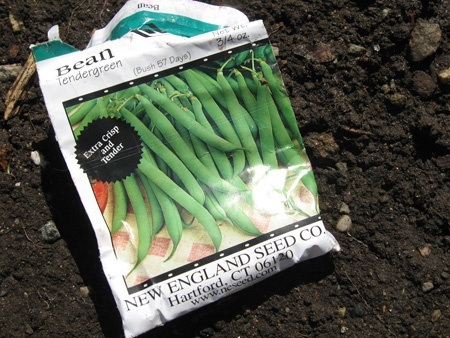
    Anytime we experience those cold, harsh winters I always welcome spring with open arms and the opportunity to work in my garden and dig in the dirt. I find it amazing to think what you can yield from one, single seed. With the proper planning, planting, watering, and harvesting, one seedling from a green bean can provide a meal, maybe two, for a family of four. Plant a whole row of seeds and you’ll be canning and freezing beans to eat well into the winter!

    How does planting a seed have anything to do with social media marketing?

    Everything you do to harvest crops from your vegetable garden you can associate to what you should do to yield a harvest of relationships and business through social media marketing.

    So let’s think about how to approach planning for your business.

    First, all businesses have highs and lows during the year. When are the high seasons for your business?  If it’s the fourth quarter of the year and you are a retail store, begin planting seeds in June. Plant the seeds by picking the products you will be selling in the 4th Quarter. Learn everything you can about the products you will be selling. Collect all the information possible about the products you will be selling. Begin a Buzz about these products well before the 4th Quarter.

    What might this look like?

    The other day I met with a new client who has a variety of high seasons for his business in the first six months of the year. For one product it’s the Spring season. Another, it’s March, April, May. And, yet another it’s January, February, March.  Needless to say, all of our planning for these will be for the whole year.

    This is what we did:

    First We looked at last year’s marketing activities for each of the products and immediately recognized gaps in marketing and some missteps due to timing and the lack of using some of the newer marketing techniques available.
    Second We visualized what the marketing should look like for each of these for next year’s campaigns. Our calendars came out and we plotted out the activities, when they should be done and by whom. We’re already ready for the whole year!
    Third We determined what needed to be added and fine tuned. We included new marketing tools. This client has an email list he can use to reach out to current clients. We decided to add an email management product to send out timely emails. This client falls under the category of a Business to Customer (B2C). They are currently on Facebook and will work on creating cover photos for each of these product lines. We added Instagram, Pinterest, and YouTube.
    Fourth Budgeting was next. What was the funding for the past events? Was the funding in balance with the results? Could have more been spent wisely for greater results? What is the projection for gross revenue? What should you spend on marketing? This is always one of those loaded questions. When starting a business or a new product your marketing budget is going to be much higher than an established business or product. The percentages for a new product could range from 8 to the extreme of 15% and established products could range from 3 to 5% or even less. This is a general rule of thumb we use as a guide.

    Are you ready to plant the seeds for marketing your business’s products or services? With proper planning, scheduling, and budgeting you will be able to harvest the results through increased business relationships and sales.

    Share this article:

    [DISPLAY_ULTIMATE_SOCIAL_ICONS]


    Alyse Mitten, owner of Interlace Communications and goMAaVA along with her team, provide  print and online marketing solutions. Interlace Communications is located in Shoemakersville, Pennsylvania and services the areas of Chester, Berks, Schuylkill, Lehigh, and beyond. Contact us at 484-709-6564, www.gomaava.com, alyse@gomaava.com. Find us on Facebook at iciconnect, Twitter at GoMAaVA and LinkedIn.

  • When will your next client need you?

    “You never know when your next client needs you until they need you.”

    –by Alyse Mitten


    This is one of my favorite sayings. And, it’s true. How many of you with brick and mortar stores and businesses take down your signage when you’re closed. Answer, “You don’t.” You are advertising even when you’re not there. Then, why is it that online businesses or in-home businesses aren’t advertising or marketing online or in print on a regular basis? Your ads are your signage telling people you are in business.When an advertiser calls me to place an ad in MACnet* for a week to see how it works, I cringe and end up refusing to place an ad for a week. I’d rather they go into less circulation for more weeks than to run an ad for one week.

    Marketing/Advertising are events not happenings. Events have a beginning, middle and an end. Happenings are just that…happenings.
    Marketing needs planning for it to be successful. It also needs to be a marketing mix to include: print, online, radio, television, billboards, networking, face-to-face, and whatever your business warrants.

    141*The classified, display and insert network for the Mid-Atlantic Community Papers Association.

    Visit www.macnetonline.com

    for more information on our networks.

    Share this article:

    [DISPLAY_ULTIMATE_SOCIAL_ICONS]