Interlace Communications

Author: Iciconnect

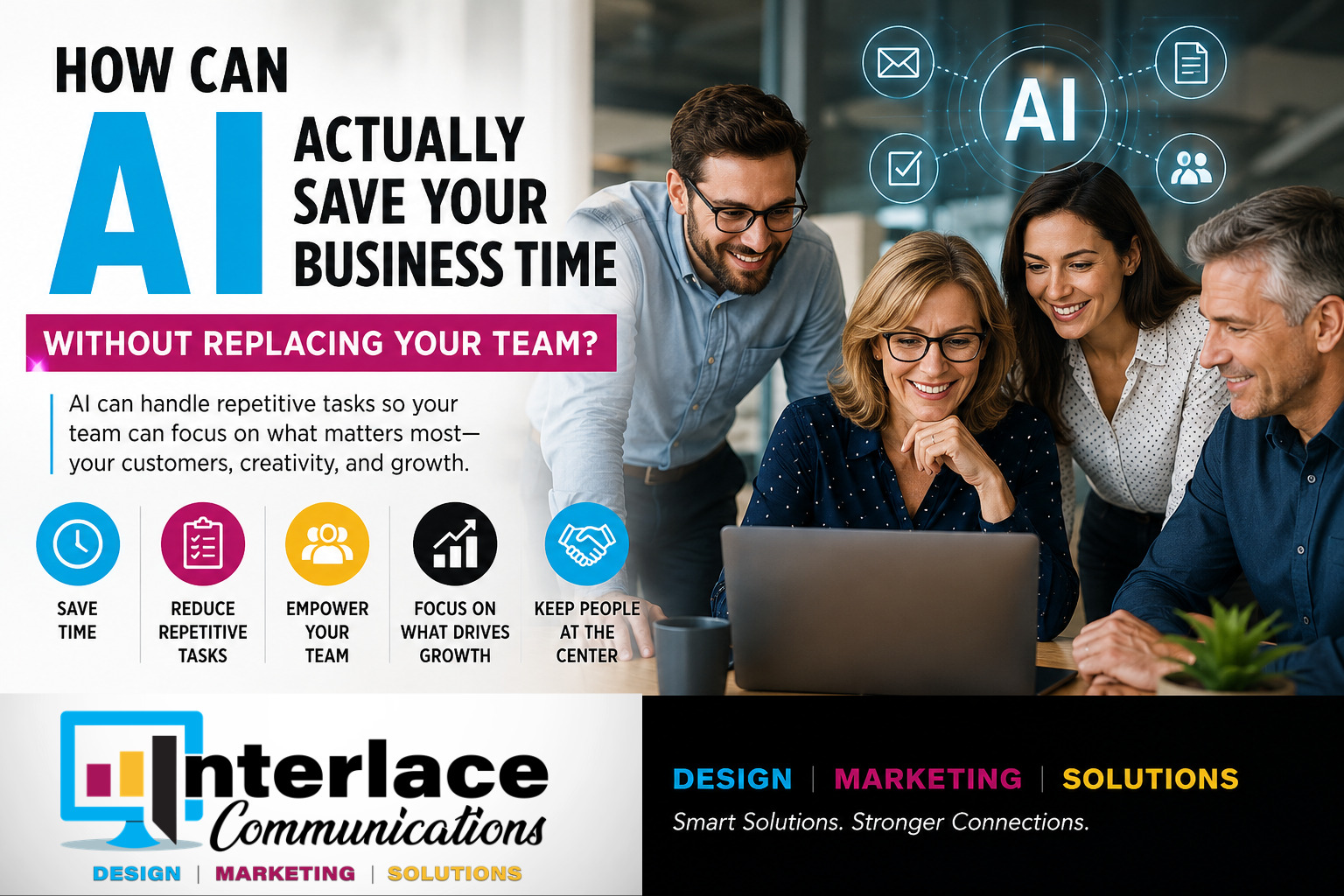
  • How Can AI Actually Save My Business Time Without Replacing My Team?

    How Can AI Actually Save My Business Time Without Replacing My Team?

    Quick Answer

    Yes—AI can save your business time without replacing your team. When used thoughtfully, AI handles repetitive tasks like drafting emails, organizing information, creating first drafts of blogs, and summarizing meetings, giving your employees more time to focus on customers, creativity, problem-solving, and the work that truly drives your business forward. The goal isn’t to replace people. It’s to help people do their best work.

    AI Isn’t Replacing Your Team. It’s Giving Them Time Back.

    One of the most common questions we hear at Interlace Communications is:

    “We’re interested in AI, but we don’t want to replace our employees.”

    It’s a fair concern.

    Every day, we’re surrounded by headlines predicting that artificial intelligence will eliminate jobs, replace entire departments, or completely change the workplace overnight. It’s enough to make any business owner wonder whether they should embrace AI — or avoid it altogether.

    After working with businesses for more than 50 years, we’ve learned something that hasn’t changed, no matter how much technology evolves.

    Businesses succeed because of people.

    Relationships matter.

    Experience matters.

    Creativity matters.

    Trust matters.

    AI doesn’t replace those things. Instead, it helps remove some of the repetitive work that often keeps talented people from doing what they do best.

    That’s why we don’t think of AI as a replacement for employees.

    We think of it as another tool in the toolbox.

    Just like email didn’t replace conversations, calculators didn’t replace accountants, and websites didn’t replace customer service, AI isn’t here to replace your team. It’s here to make their work more efficient.

    Why Are So Many Business Owners Hesitant About AI?

    Most business owners aren’t afraid of technology. They’re afraid of making the wrong decision.

    Some worry they’ll invest in the wrong tools. Others worry their employees will resist the change. Many simply don’t know where to begin. Those concerns are completely understandable.

    The truth is, AI has developed incredibly fast. New tools seem to appear every week, and every headline promises the next revolutionary breakthrough.

    It can feel overwhelming.

    But here’s something we tell clients all the time:

    You don’t need to know everything about AI to benefit from it.

    You simply need to understand where it fits into your business.

    Where Does AI Actually Save Time?

    Most people imagine AI doing huge, complicated jobs. In reality, the biggest time savings usually come from the small tasks that quietly consume hours every week.

    Think about your own day.

    How much time do you spend:

    • Writing emails?
    • Creating social media posts?
    • Taking meeting notes?
    • Searching for information?
    • Summarizing long documents?
    • Brainstorming ideas?
    • Creating first drafts?
    • Organizing project information?

    Individually, these tasks may only take a few minutes.

    Together, they can consume several hours every single week.

    That’s where AI shines.

    Instead of starting from a blank page, AI helps you start with a draft.

    Instead of spending an hour organizing notes, it can summarize them in seconds.

    Instead of staring at an empty screen trying to think of marketing ideas, it can generate dozens of possibilities you can build upon.

    The important word here is build.

    AI creates the starting point.

    People provide the experience, judgment, and final decisions.

    Think Less About Jobs—And More About Tasks

    One of the biggest misconceptions surrounding AI is that it replaces jobs.

    That’s not how we approach it.

    Instead, we encourage business owners to think about tasks rather than job titles.

    For example, imagine someone on your team who spends part of every week:

    • Answering routine emails
    • Creating meeting summaries
    • Drafting newsletters
    • Updating website content
    • Writing social media posts
    • Organizing client information

    Those repetitive tasks are perfect opportunities for AI assistance.

    Now think about everything else that employee does.

    • Building relationships
    • Helping customers
    • Solving unexpected problems
    • Training coworkers
    • Making decisions
    • Showing empathy
    • Representing your company

    AI can’t replace those human qualities.

    In fact, by reducing repetitive work, AI often allows employees to spend more time doing the work only people can do.

    We Like to Think of AI as the World’s Fastest Intern

    When Alyse speaks to business owners and organizations, she often uses a simple comparison.

    Imagine hiring an intern. They’re eager to help. They’re incredibly fast. They never complain. They’re available almost anytime.

    But they also have one important limitation. They only know what you tell them.

    Give an intern vague instructions, and you’ll probably receive disappointing results. Provide clear direction, examples, and context, and suddenly that intern becomes an incredible asset to your business.

    AI works much the same way.

    It doesn’t replace your experience. It learns from your instructions. The better your prompts, the better your results.

    That’s why learning how to communicate with AI is often more valuable than simply learning another piece of software.

    The Businesses Seeing the Greatest Success Aren’t Replacing Employees

    They’re removing unnecessary work.

    They’re allowing their teams to spend less time formatting documents and more time serving customers.

    They’re reducing hours spent on repetitive administrative work.

    They’re improving communication.

    They’re organizing information more effectively.

    Most importantly, they’re creating room for people to focus on work that requires creativity, judgment, leadership, and genuine human connection.

    That’s where the real value of AI begins.

    What Happens When Businesses Wait Too Long?

    One of the biggest risks today isn’t using AI incorrectly.

    It’s not using it at all.

    We’ve watched technology evolve for decades. Businesses that adapted to websites, email marketing, search engines, and social media often found new opportunities while others struggled to catch up. Artificial intelligence is following a similar path.

    That doesn’t mean you need to rush out and buy every AI tool on the market. It does mean now is the time to start learning, experimenting, and understanding where AI can make a meaningful difference in your business.

    Even small improvements can add up. Saving just 30 minutes a day equals more than 120 hours over the course of a year. Imagine what your team could accomplish with that extra time.

    The Biggest Mistake We See Businesses Make

    The biggest mistake isn’t choosing the wrong AI platform.

    It’s expecting AI to solve business problems without having a clear process in place.

    AI can’t fix a broken workflow. It can’t replace poor communication. It can’t make up for unclear goals.

    What it can do is make good processes even better.

    For example, if your team already has a consistent way of responding to customer inquiries, AI can help draft those responses more quickly. If you already publish regular marketing content, AI can help brainstorm ideas, organize information, and create first drafts.

    Successful businesses don’t ask AI to run the business.

    They ask AI to help the business run more efficiently.

    Where Should Your Small Business Start?

    One of the questions we hear most often is, “Where do we even begin?”

    Our answer is surprisingly simple.

    Start small.

    Choose one repetitive task that takes more time than it should.

    That could be:

    • Writing follow-up emails
    • Summarizing meeting notes
    • Creating social media captions
    • Drafting blog outlines
    • Organizing project information
    • Creating job descriptions
    • Developing training materials

    Once your team becomes comfortable using AI for one task, you’ll naturally begin identifying other opportunities.

    Trying to transform your entire business overnight usually creates frustration.

    Building confidence one success at a time creates momentum.

    AI Works Best When People Stay in Control

    One thing we emphasize in every workshop and consulting session is that AI should support your decisions — not make them for you.

    Every piece of content should be reviewed.

    Every important communication should be checked.

    Every recommendation should be evaluated by someone who understands your customers and your business.

    Think of AI as your first draft—not your final answer.

    That’s where businesses find the greatest value.

    At Interlace Communications, We Believe AI Should Feel Approachable

    Artificial intelligence doesn’t have to be intimidating.

    It doesn’t require learning complicated programming languages or becoming a technology expert.

    It starts with understanding your business.

    Before we recommend a single AI tool, we spend time learning how your organization operates, where your team spends the most time, and what challenges you’re trying to solve.

    Sometimes the answer isn’t AI at all.

    Sometimes it’s improving your website, automating a marketing process, creating better documentation, or simplifying communication.

    Other times, AI becomes the missing piece that helps everything work together more efficiently.

    Our goal has never been to sell technology.

    Our goal is to help businesses use technology with confidence.

    Small Shifts Lead to Real Results

    The businesses seeing the greatest success with AI aren’t replacing employees or reinventing everything they do.

    They’re making thoughtful improvements.

    They’re giving employees better tools.

    They’re removing repetitive work.

    They’re creating more time for innovation, customer service, relationship building, and strategic thinking.

    Those are the things that continue to set great businesses apart.

    Technology will continue to evolve.

    The businesses that thrive will be the ones that learn to evolve with it while keeping people at the center of everything they do.

    Let’s Talk About What’s Possible

    Have you been wondering whether AI could help your business—but weren’t sure where to begin—we’d love to have that conversation.

    Whether you’re exploring AI for the first time, looking to improve your marketing, streamline everyday tasks, strengthen your website, or create a long-term strategy, we’re here to help you take practical next steps that make sense for your business.

    Artificial intelligence doesn’t have to replace your team.

    It can become one of the most valuable tools your team has.

    Let’s talk about what’s possible.

    Frequently Asked Questions

    Will AI replace my employees?

    Not when it’s implemented thoughtfully. Most businesses use AI to automate repetitive tasks so employees can spend more time serving customers, solving problems, and growing the business.

    What types of businesses can benefit from AI?

    Nearly every organization can benefit, including manufacturers, professional offices, nonprofits, retailers, contractors, healthcare providers, educational organizations, and service businesses. The key is finding the right applications for your specific goals.

    Do I need technical experience to start using AI?

    No. Many AI tools are designed for everyday business users. The biggest challenge isn’t learning the technology—it’s learning how to ask good questions and apply AI responsibly.

    Is AI safe to use for business?

    It can be, provided it’s used with clear policies and an understanding of privacy, security, and responsible practices. That’s why we encourage businesses to establish guidelines before using AI with sensitive information.

    How do I know where AI could help my business?

    Start by looking for repetitive tasks that consume time every week. Those activities often provide the quickest return on investment and help your team become comfortable using AI before expanding into larger projects.

    Why work with Interlace Communications instead of figuring it out ourselves?

    You certainly can explore AI on your own. What we provide is experience, strategy, and practical guidance. We help businesses avoid common mistakes, identify meaningful opportunities, and implement AI in ways that support their employees, strengthen their marketing, and align with their long-term goals.

  • Why Aren’t More Small Businesses Using AI Yet?

    Why Aren’t More Small Businesses Using AI Yet?

    Quick Answer

    Most small businesses are not avoiding AI because they dislike technology. They’re avoiding it because they are busy, uncertain, and often overwhelmed by the amount of information available. The good news is that AI doesn’t require a computer science degree or a complete business overhaul. Small businesses can start with simple, practical uses that save time and improve productivity.

    The Question I Hear Everywhere

    Over the past year, I’ve spoken with business owners throughout Berks County, Schuylkill County, and beyond about artificial intelligence.

    Some are excited, some are curious, but many are cautious.

    And a surprising number tell me the same thing.

    “I know I should be looking at AI, but I don’t know where to start.”

    That response isn’t unusual.

    In fact, it may be the biggest reason many small businesses haven’t embraced AI yet.

    It’s not resistance.

    It’s uncertainty.

    Is AI Really That Complicated?

    The media often makes AI sound incredibly complicated.

    Business owners hear terms like:

    • Large Language Models
    • Machine Learning
    • Neural Networks
    • Agents
    • Automation

    Before long, many conclude that AI is something only large corporations can afford to understand.

    The reality is much simpler.

    Many business owners are already using AI without realizing it.

    Email filters, navigation apps, recommendation engines, and voice assistants all rely on AI.

    The challenge is understanding how AI can help your specific business.

    Are Business Owners Afraid AI Will Replace Employees?

    This concern comes up frequently.

    Many people worry that AI will eliminate jobs.

    What we’ve seen instead is that AI often helps people perform their jobs more efficiently.

    Think about the tasks that consume hours each week:

    • Drafting emails
    • Writing social media posts
    • Creating blog outlines
    • Researching topics
    • Summarizing meetings
    • Organizing information

    AI can assist with these tasks, allowing employees to focus on work that requires creativity, judgment, and personal interaction.

    The goal is helping people work smarter.

    The Biggest Barrier Isn’t Technology

    It’s time.

    Small business owners wear multiple hats every day.

    They’re managing employees, serving customers, handling paperwork, following up on leads, and putting out fires.

    Learning a new technology often falls to the bottom of the list.

    That’s why many businesses delay exploring AI.

    Not because they don’t see value.

    Because they don’t feel they have time.

    What Can AI Actually Help a Small Business Do?

    This is where the conversation gets interesting.

    AI can help businesses:

    Create Marketing Content

    Generate blog ideas, social media posts, email newsletters, and promotional materials.

    Improve Customer Communication

    Draft responses, organize customer inquiries, and create helpful resources.

    Streamline Operations

    Document processes, summarize meetings, and organize internal knowledge.

    Support Research

    Gather information faster and identify trends affecting the business.

    Improve Productivity

    Reduce time spent on repetitive tasks.

    Notice something important.

    None of these require replacing employees.

    They simply help businesses work more efficiently.

    What Happens When Businesses Wait Too Long?

    The businesses that concern me most aren’t the ones experimenting with AI.

    They’re the ones ignoring it completely.

    Every major technology shift creates opportunities.

    The internet did.

    Email did.

    Social media did.

    Mobile devices did.

    AI is no different.

    Businesses that begin learning now will have an advantage over those who postpone the conversation indefinitely.

    That doesn’t mean rushing into every new tool.

    It means becoming informed.

    Starting Small Is Often the Best Approach

    One of the biggest misconceptions about AI is that implementation must be massive.

    It doesn’t.

    A simple starting point might include:

    ✓ Using AI to brainstorm blog topics

    ✓ Drafting email newsletters

    ✓ Creating social media content

    ✓ Summarizing meeting notes

    ✓ Developing FAQs for customers

    Small wins build confidence.

    Confidence creates momentum.

    Momentum creates results.

    What We’ve Learned Working With Businesses

    At Interlace Communications, we’ve found that most business owners don’t need more technology.

    They need practical guidance.

    They need someone to translate AI into plain English.

    They need examples that relate to their business.

    Most importantly, they need to understand that AI is a tool, not a replacement for human expertise.

    The businesses finding success with AI are using it to enhance what they already do well.

    The Real Question Isn’t Whether AI Is Coming

    It’s already here.

    The real question is whether your business will learn how to use it effectively.

    You don’t need to become an AI expert overnight.

    You don’t need to transform your entire operation tomorrow.

    You simply need to take the first step.

    The businesses that begin learning today will be better prepared for the opportunities ahead.

    Let’s Talk About What’s Possible

    Should you be curious about AI, but unsure where to begin, you’re not alone.

    We work with business owners throughout Pennsylvania and beyond who are asking the same questions.

    Our goal isn’t to overwhelm you with technology.

    Our goal is to help you discover practical ways AI can support your business, save time, and create new opportunities for growth.

    The first conversation is often the most important one.

    Let’s talk about what’s possible.

    Frequently Asked Questions

    Do I need technical experience to use AI?

    No. Many AI tools are designed for everyday business users.

    Is AI expensive?

    Some tools are free, while others have affordable monthly subscriptions.

    Will AI replace my employees?

    Most businesses use AI to support employees, not replace them.

    What’s the easiest way to start using AI?

    Begin with content creation, brainstorming, or administrative tasks.

    Is AI safe for business use?

    It can be, when used thoughtfully and with proper policies in place.

    How can Interlace Communications help?

    We provide practical guidance, training, consulting, and implementation support tailored to small businesses.

  • May Is National Small Business Month: Why It Matters More Than You Think

    May Is National Small Business Month: Why It Matters More Than You Think

    You probably know a small business owner. Maybe you are one. Maybe you grew up watching your parents run one from the kitchen table while dinner got cold. Or maybe you became one yourself because somebody once told you your idea was worth trying and you believed them.

    May is National Small Business Month. It has been for decades. But this year it is a little different.

    The Backbone Nobody Talks About

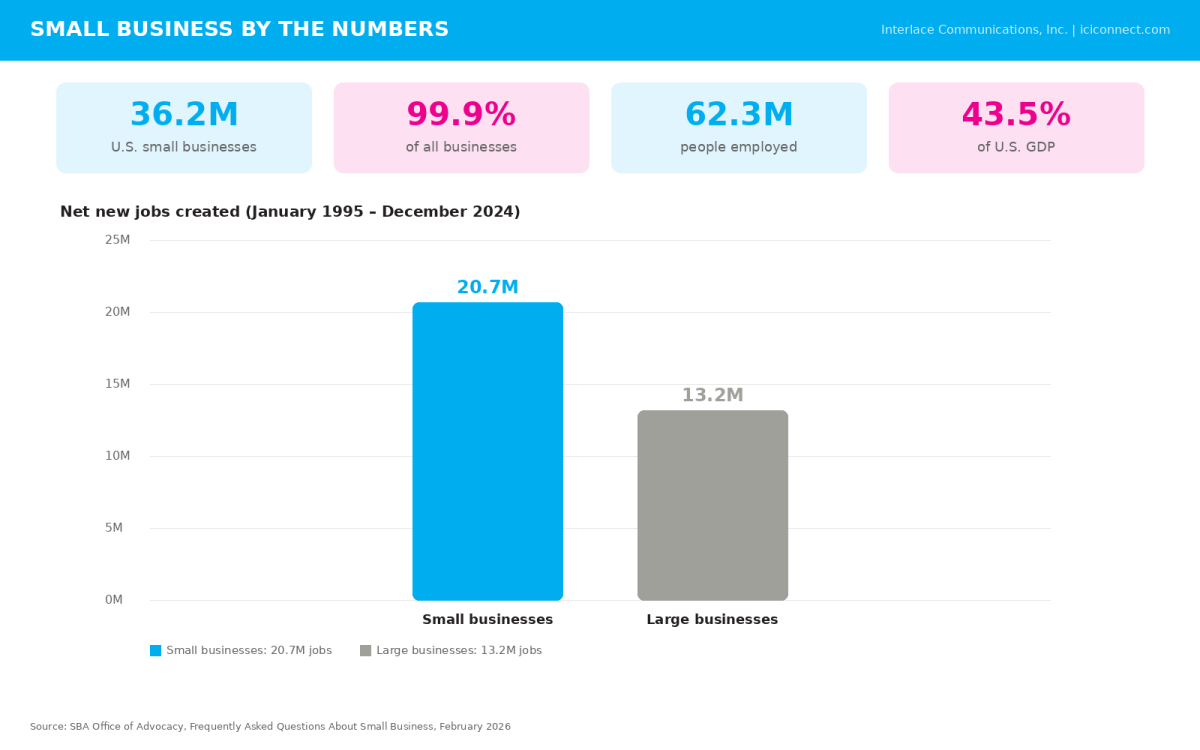
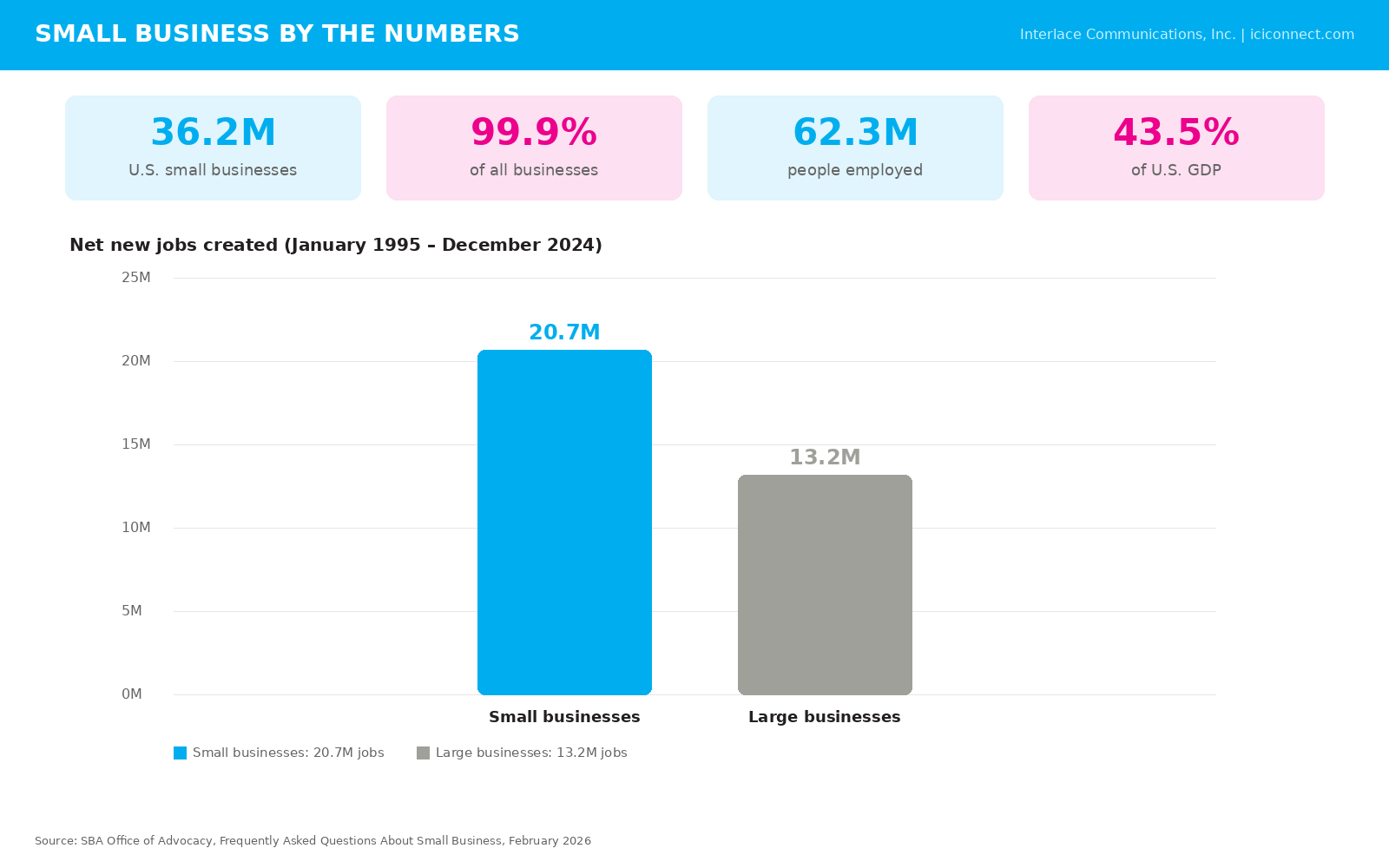
    Here is something that still catches people off guard. Small businesses account for 99.9% of all businesses in the United States. Not a typo. Nearly every business in this country is a small one. They produce 43.5% of the nation’s gross domestic product and over the last three decades they have created more than 20 million jobs. More than half the American workforce clocks in every morning at a small business.

    Those numbers are massive. But they do not tell the whole story.

    What the data misses is the contractor who answers the phone at 9 p.m. because a homeowner has a leak. The accountant who stays late in March so her clients can sleep at night. The print shop that donates flyers for the church fundraiser every single year without being asked. That is what a small business really looks like. It looks like people showing up for their neighbors.

    Small Business by the Numbers: SBA Office of Advocacy, Frequently Asked Questions About Small Business, February 2026 (advocacy.sba.gov)

    This Week is the Big One

    National Small Business Week 2026 runs the first full week of May. The Small Business Administration hosts a free Virtual Summit with workshops on everything from digital marketing to scaling your operations. State or local business organizations often hold events that week or through the month to celebrate on a smaller scale. Check out your own local programs and attend events with your fellow small business owners.

    But honestly the celebration does not need to stop after one week. The entire month of May belongs to the businesses that keep our communities stitched together.

    What This Month Can Do for Your Business

    Take a breath and look at your own operation for a minute. When was the last time you read your own website the way a stranger would? Does it answer the questions people are actually asking before they call you? Are your blogs doing real work or are they just filling space?

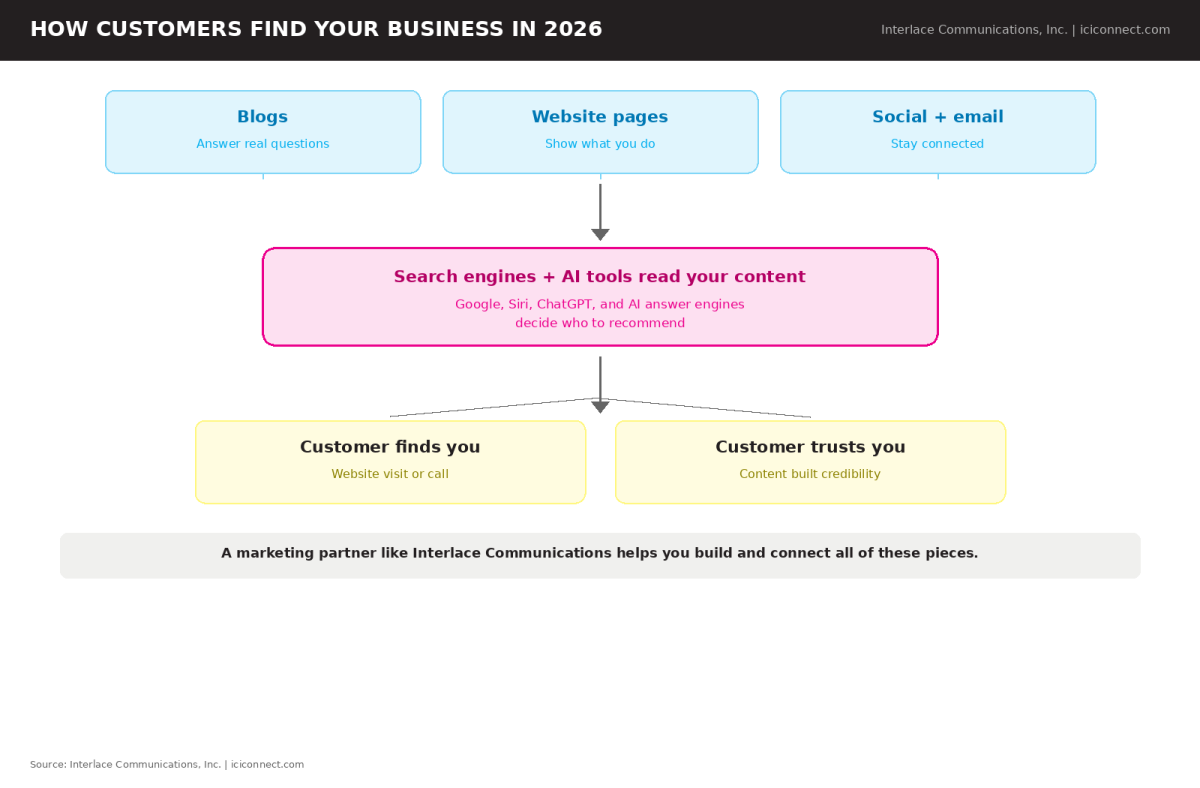
    In 2026 the way people find businesses has changed. Search engines and AI tools are reading your content and deciding whether to recommend you. That is not a theory. That is happening right now. Businesses that publish clear and helpful content get discovered. Businesses that stay quiet get passed over. A strong website and a steady blog are not luxuries anymore. They are how you stay visible.

    And here is the thing most business owners forget. You do not need to overhaul everything at once. Start with one blog that answers a question your customers ask you all the time. Update your About page so it no longer sounds like a brochure from 2014. Small moves add up.

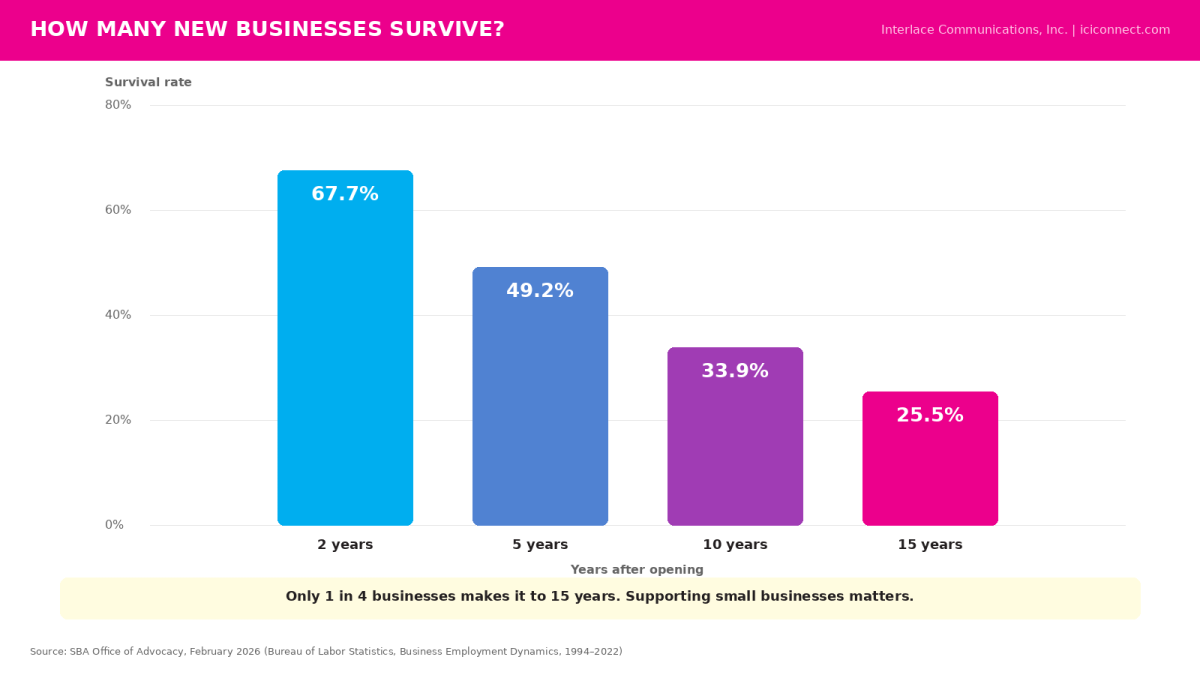
    Survival Rates: SBA Office of Advocacy, February 2026; Bureau of Labor Statistics, Business Employment Dynamics (1994–2022)

    How Everyone Else Can Help

    Not a business owner? You still have a role to play this month. Buy a gift card from a local shop. Leave a review for that restaurant you keep meaning to recommend. Share a post. Tell a friend. Show up at the farmers market this weekend and say hello to the people behind the tables. It costs nothing and it means everything to someone who bet their savings on a dream.

    Frequently Asked Questions About National Small Business Month

    What is National Small Business Month?

    Every May the United States sets aside the entire month to recognize and celebrate the contributions of small business owners. The tradition goes back decades. The U.S. Small Business Administration leads the effort by hosting events and highlighting entrepreneurs who make a real difference in their communities.

    It is time to acknowledge that the backbone of this country’s economy is not Wall Street or Silicon Valley. It is the local businesses on Main Street that hire our neighbors and sponsor our kids’ teams.

    What is National Small Business Week 2026?

    National Small Business Week is the centerpiece of the month. In 2026 it ran from May 3 through May 9. The SBA hosted a free Virtual Summit on May 5 and 6 packed with workshops on topics like digital marketing strategy and business growth. They also announce their annual small business award winners during the week. Whether you attended in person or tuned in online, the week is a solid opportunity to learn something new and connect with other business owners who understand exactly what you are going through.

    If you missed this year, put next year’s dates in your calendar to attend in 2027.

    How can I support small businesses in my community?

    This one is easier than most people think. Buy from a locally owned shop instead of ordering online when you can. Leave a Google review for a business you love. Share their social media posts. Recommend them to a friend. Purchase gift cards from local restaurants and service providers as birthday or holiday gifts. Attend a community event like a farmers market or a local fair where small businesses set up and sell. Every one of those actions puts real dollars and real visibility behind someone who poured their heart into building something from scratch.

    Why does my small business need a blog?

    Because in 2026 your blog is one of the most powerful marketing tools you have. A blog does more than keep your website looking current. It tells search engines and AI-powered search tools what your business knows and who it serves.

    When someone in your area types a question into Google or asks an AI assistant for a recommendation, your blog content is what those systems read to decide whether your business is a good match. Without it you are invisible to a growing number of potential customers. A well-written blog also builds trust with the people who do find you. It shows them you understand their problems before they ever pick up the phone. That kind of credibility is hard to buy with advertising alone.

    The businesses that blog consistently with clear and helpful content see more website traffic and more inquiries over time. It is not magic. It is marketing that works.

    How Customers Find Your Business in 2026: Interlace Communications, Inc. (original educational graphic)

    How do I make my small business easier to find online?

    Start with the basics. Your website needs to load quickly and look professional on a phone because that is where most people are searching. Your content needs to answer real questions that your ideal customers are asking. Search engine optimization helps your site rank higher on Google and AI-driven answer engines are now pulling directly from well-structured website content to recommend businesses in their results.

    Beyond your website, a consistent social media presence keeps your brand in front of people between searches. Email marketing helps you stay connected with customers who already know you. And do not underestimate commercial printing. Brochures, business cards and direct mail pieces still work especially when they match the same branding your audience sees online. The key is making sure all of these pieces work together instead of operating in silos.

    A full-service marketing partner, like Interlace Communications, can help you build that kind of connected strategy so nothing falls through the cracks.

    Small Shifts Lead to Real Results

    Every big brand started as a small one. Every household name began with someone who had no guarantee it would work. Supporting small businesses is not charity. It is an investment in the neighborhoods and families and communities that make a place feel like home.

    At Interlace Communications, we have spent more than 30 years helping small businesses across Pennsylvania and beyond get found and get remembered using:

    • Website design.
    • Blog management.
    • Search engine optimization.
    • Email marketing.
    • Social media marketing.
    • AI consulting and training.
    • Commercial printing.

    We do all of it because we believe in the people doing the work.

    Let’s talk about what’s possible for your business.

    Reach out to Interlace Communications at 484-709-6564 or visit our Help Desk.

  • Why Does My Content Get Ignored… Even When I’m Posting Consistently?

    Why Does My Content Get Ignored… Even When I’m Posting Consistently?

    If your content isn’t getting attention, it’s not because your message is wrong… it’s because attention has changed. Static posts are easier to scroll past, while motion-based content naturally pauses the eye. A simple shift to scroll stopping content can make the difference between being skipped… or being seen.


    You sit down.
    >You write the post.
    >You share something helpful… maybe even really good.

    And then…

    Nothing.

    A few likes. Maybe a comment. Mostly silence.

    So you wonder…
    “Is it me?”
    “Is it the message?”
    “Am I just not good at this?”

    But here’s the truth.

    It’s not you.

    It’s the way content is being seen… or more accurately, not seen.


    What We Saw in March… And Why It Matters Now

    In March, we focused on something most business owners feel but don’t always say out loud…

    Everything takes too long.

    Creating content. Building presentations. Trying to keep up.

    And once people saw a better way to do it, something clicked.

    Relief.
    Clarity.
    Momentum.

    But then came the next question…

    “Okay… this is faster now. But why isn’t it getting noticed?”

    That’s where things start to change.

    The Problem Isn’t Your Content… It’s Attention

    You’re not competing against bad content.

    You’re competing against everything.

    Every scroll, every distraction, every split-second decision someone makes while looking at their phone.

    And right now…

    Still images just don’t behave the way they used to.

    They don’t stop the scroll.

    They blend in.


    What Happens When Content Blends In

    This is the part that gets frustrating.

    You can be consistent.
    >You can be thoughtful.
    >You can even be doing everything “right.”

    And still…

    • Your posts get skipped
    • Your message doesn’t land
    • Your effort doesn’t turn into action

    Not because it’s wrong.

    Because it never got the chance to be see

    Ever Feel Like Your Posts Just Blend In?

    You share good content. You post regularly. And still… it barely gets noticed.

    It’s not because your message is wrong. It’s because still images don’t behave the way they used to.

    In this workshop, we’ll talk about why movement matters now… why attention pauses for just a few seconds… and how some posts quietly earn that pause while others disappear.

    No filming.
    >No editing skills.
    >No pressure to be on camera.

    Just a smarter way to help your content get seen without starting from scratch.

    Once you understand this shift, static posts won’t look the same again.


    Why Motion Changes Everything

    Static Content Motion-Based Content
    Easy to scroll past Pauses attention
    Blends into the feed Stands out naturally
    Lower engagement Higher interaction
    Often ignored Invites curiosity

    This isn’t about doing more.

    It’s about finally being seen.


    3 Reasons Your Content Isn’t Getting Noticed Anymore

    • The feed is faster than ever
      People react before they read
    • Still images don’t interrupt behavior
      They look like everything else
    • Attention is earned in seconds
      Not minutes… seconds


    A Note From Alyse

    “Most business owners don’t need more content… they need their content to actually be seen. Once you understand how attention works today, what you’re already creating starts working for you in a completely different way.”


    FAQ… Let’s Keep This Real

    Do I have to be on camera?
    No. You don’t need to film yourself to create motion.

    Is this hard to learn?
    Not at all. Once you see it, it makes sense quickly.

    Will this work for my business?
    Yes. Attention works the same way whether you’re a local service, nonprofit, or growing company.

    Here’s What to Do Next

    You don’t need to start over. You just need your content to get a fair shot at being seen.

    Workshop: Scroll Stopping Video Tricks
    📅 April 15, 2026
    🕓 4:00 PM (EST)
    👉 https://ici4u.com/ScrollStoppingVids

    And should you want help applying this to your business… not just learning it…

    Because when your content gets noticed… everything else starts to follow.

  • AI Presentations for Business Owners: Presentations in Minutes, Not Hours

    AI Presentations for Business Owners: Presentations in Minutes, Not Hours

    How many times have you opened PowerPoint… stared at a blank slide… and thought: Why is this taking so long?

    You adjust a headline. Move a box. Resize a graphic. Rewrite the first slide again.

    Suddenly it’s 11:47 PM and you haven’t even practiced yet.

    You’re not bad at presentations. You’re overloaded.

    AI presentations help business owners create slides faster by eliminating blank-slide friction, structuring ideas instantly, and reducing repetitive formatting decisions. Instead of spending 2–4 hours building a deck manually, AI tools generate organized content in minutes so leaders can focus on clarity, confidence, and impact.

    The Real Problem Isn’t PowerPoint

    Most people assume the issue is skill. It’s not. It’s cognitive overload.

    Every slide forces dozens of micro-decisions:

    • What goes first?
    • Is this too much text?
    • Does this flow logically?
    • Why doesn’t this look right?

    You’re designing while thinking and that drains energy fast.

    McKinsey reports knowledge workers spend nearly 20 percent of their week searching for and organizing information. Microsoft’s Work Trend Index (2023–2024 Reports on Digital Overload and Productivity) highlights rising digital overload and constant context switching. Task switching quietly erodes productivity. Now add a 20-slide deck after a full day of meetings.

    Of course it takes hours. Of course it feels heavy.

    Here’s the part most leaders underestimate: When your thinking is overloaded, your message weakens. Your audience feels it. Decisions slow down. Momentum stalls.

    AI presentations aren’t about prettier slides. They’re about clearer thinking.

    What’s Really Slowing You Down

    It’s rarely your creativity. It’s friction inside the workflow:

    • Starting from a blank slide with no structure
    • Editing content while designing layout
    • Rewriting because the flow isn’t clear
    • Fixing formatting inconsistencies late
    • Trying to polish everything under pressure

    This isn’t a talent issue. It’s a process issue. And the process can be redesigned.

    Traditional vs AI-Driven Presentation Workflow

    Traditional Process AI-Driven Process Impact
    Blank slide start Structured outline in minutes Immediate clarity
    Manual drafting Organized content generated fast Fewer decisions, less fatigue
    Slide-by-slide formatting Consistent layout applied instantly No late-night cleanup
    Endless tweaking Strategic refinement Stronger delivery
    2–4 hours per deck First draft in under 30 minutes Time back in your week

    One recent attendee rebuilt a board presentation in 28 minutes using this system.
    Previously it took her nearly three hours.

    That’s not magic. That’s the structure. This isn’t about replacing you.

    It’s about removing friction so your thinking gets sharper and your time stays yours.

    A Strategic Insight from Interlace Communications

    “Most presentations stall because leaders try to solve structure and design at the same time,” says Alyse Mitten, founder of Interlace Communications.
    “When AI handles structure, you free mental space for strategy. Clarity isn’t just better slides. It leads to faster buy-in, stronger decisions, and trust in the room.”

    Not flashy tools.

    Not complicated software.

    A smarter system for how you already work.

    Introducing the Workshop: Presentations in Minutes, Not Hours

    📅 March 18, 2026
    🕓 4:00 PM EST
    💻 Live Zoom AI Training Workshop
    🔗 https://ici4u.com/PresentInMinutes

    This workshop is built for business owners, nonprofit leaders, and managers who are tired of finishing slide decks at night.

    It’s not a design tutorial. It’s a practical system for presentation productivity.

    You’ll learn how to:

    • Create presentations faster using AI tools
    • Separate thinking from formatting
    • Reduce decision fatigue
    • Build repeatable presentation workflows

    Every session includes AI tools. Some developed by the Interlace team. Others from trusted developers. All designed for real-world implementation.

    Not theory. Application you can use the very next day.

    💵 Cost: $27
    ⭐ MAP Clients attend FREE

    Frequently Asked Questions

    Is this for beginners?
    Yes. If you use PowerPoint, Google Slides, or similar tools, you’re ready. No advanced AI knowledge required.

    Will this replace my software?
    No. This enhances your existing workflow. It’s about time savings, clarity, and structure.

    Is this relevant for board meetings or fundraising presentations?
    Absolutely. Clear structure improves persuasion, confidence, and message flow.

    Is the training live?
    Yes. March 18 at 4:00 PM EST via Zoom.

    What if I want deeper implementation support?
    Interlace Communications offers done-with-you and done-for-you AI workflow design through its MAP program for teams that want this embedded into daily operations.

    The Real Cost of Doing Nothing

    Another late night before a big meeting.

    Another deck that feels rushed.

    Another presentation where your message almost landed… but didn’t fully move the room.

    Lost time.
    Lost clarity.
    Lost momentum.

    Time is expensive.

    Clarity drives decisions.

    And confident delivery builds trust faster than any graphic ever could.

    For $27, the return on your reclaimed hours makes this workshop an easy decision.

    For MAP Clients, it’s already included.

    Ready to Stop Losing Hours to Slide Decks?

    Join us for Presentations in Minutes, Not Hours

    📅 March 18, 2026
    🕓 4:00 PM EST
    🔗 https://ici4u.com/PresentInMinutes

    Secure your seat.

    And should you decide you’d rather not engineer this system alone, Interlace Communications can help you implement AI presentations and workflow systems directly into your business.

    Because your time shouldn’t disappear inside slide decks.

    It should be spent leading.

  • Why Your Blog Isn’t Getting Found (and How to Fix It Without Writing More)

    Why Your Blog Isn’t Getting Found (and How to Fix It Without Writing More)

    Have you been posting blogs… but your phone still isn’t ringing from your website?

    You update pages.
    You share posts on Facebook.
    You know people are searching for what you do.

    Yet a competitor you barely recognize keeps appearing first. You’re not failing at blogging. You’re dealing with a visibility issue — and it’s affecting a surprising number of established, reputable businesses.

    For years the advice was simple: “Keep publishing content and Google will reward you.”

    That advice quietly expired because search engines changed what they reward.

    Why your blog isn’t getting found:

    Business blogs don’t rank when they act like company updates instead of customer answers. Modern Google and AI search prioritize structured explanations, question-based headings, and topic authority. Visibility now depends on clarity and organization — not posting frequency.


    What’s Actually Happening

    Here is the pattern Interlace sees every month: A company builds a website. They occasionally post blogs like:

    • project photos
    • announcements
    • seasonal reminders
    • company news

    The website looks active, but to a search engine the business has never clearly demonstrated expertise.

    Google still answers your customers’ questions. Just not using you.

    You keep referrals.
    You stay busy.

    But the people searching today — the ones who don’t already know you — never find you. And that produces a very specific problem:

    Your reputation exists offline.
    Your discoverability does not exist online.


    Why Search Changed

    Search engines now evaluate credibility using E-E-A-T: experience, expertise, authority, and trust. In plain terms, Google is asking “Would this business teach a confused customer clearly?”

    At Interlace, we explain it this way: Blogging is no longer a promotion. It is an explanation.

    The businesses that explain problems best get introduced to customers first. That is also how AI Overviews choose who to reference.

    For example:

    A roofer publishing a blog like, “How long does a roof replacement take in Berks County?” will consistently outrank one posting, “We completed another roof this week.”

    Same work. Different visibility.


    Why Writing More Won’t Fix It

    What Businesses Do What Search Needs
    Frequent posts Clear answers
    Service descriptions Customer questions
    Isolated articles Connected expertise
    Activity Guidance

    One well-organized article answering real questions will outperform months of scattered updates.


    The Quiet Cost

    Here’s the part most owners don’t notice: Nothing breaks.

    Your business continues and you remain busy, but your growth ceiling lowers.

    Someone else becomes the online expert in your field — not because they’re better at the service, but because search engines understand them better. Visibility compounds. So does invisibility.


    How Smart Businesses Are Using Blogs Now

    Businesses gaining traction treat blogs as a knowledge library, not a news feed.

    They:

    • answer common customer questions,
    • connect related topics,
    • improve older articles,
    • and reuse content across email, social, and training.

    That is exactly what the recent Interlace workshop “Blogs That Bring You Business” taught.

    And it leads directly to the next step.

    Once your knowledge is structured, AI tools can instantly turn it into presentations, proposals, and client education — which is the focus of the upcoming workshop:

    “Spent 3 Hours on a Presentation? There’s a Better Way.”

    The same structure that helps customers find you also gives you your time back.


    When Owners Recognize the Problem

    Many owners eventually say: “My website looks professional… but it doesn’t bring in new customers.”

    That’s not a design problem, it’s a visibility system problem.

    Interlace doesn’t just create posts. They build a framework where your expertise continues working even while you’re running the business. You can learn to implement it through the workshops, or you can have it handled.

    Both options exist because business owners usually reach the same conclusion:

    Understanding the strategy and having time to execute it are two very different things.


    FAQ

    Do I need to blog weekly?
    No. Organized authority matters more than frequency.

    Will AI replace websites?
    No. AI pulls answers from well-structured websites.

    How long before results?
    Typically 2–4 months once content answers real customer questions consistently.

    Can social media replace blogs?
    No. Social media spreads awareness. Blogs create discoverability.


    The Next Step

    If strangers aren’t contacting you through your website, effort probably isn’t the issue. Search engines simply don’t yet recognize your expertise. Once they do, they begin introducing your business to customers you’ve never met — automatically.

    And that’s when a website stops being a brochure…

    …and starts quietly becoming your most consistent source of new opportunities.

  • Are Your Blogs Quietly Determining Whether AI Recommends Your Business in 2026?

    Are Your Blogs Quietly Determining Whether AI Recommends Your Business in 2026?

    Many business owners believe their website exists to describe what they do.

    Services page.
    About page.
    Maybe a few photos.

    And somewhere on the site — a blog.

    The blog often feels optional. Something useful for SEO, something nice to have when time allows, but not essential to day-to-day operations.

    That assumption used to be harmless. In 2026, it isn’t.

    Today, potential customers often don’t start by visiting websites at all. They start by asking a question into Google, Siri, or an AI search tool:

    • “Who fixes foundation cracks near me?”
    • “What does a business liability policy actually cover?”
    • “Do I need a medical billing service for a new practice?”

    Instead of showing ten blue links, modern search systems increasingly provide direct answers — and within those answers, they choose which businesses to reference, recommend, or lead a user toward contacting.

    Those recommendations do not come from advertisements. They come from content.

    In 2026, blogs are no longer simply marketing content. They act as discovery signals that help search engines and AI systems understand what a business actually knows and when it should be recommended. Clear, structured blog articles allow search systems to connect specific customer problems with the businesses best suited to solve them.

    Why This Change Matters More Than It Appears

    Search behavior has shifted from keywords to questions. Years ago, a homeowner might search “roof repair cost.” Now they ask: “Why is water dripping from my ceiling after snow melts?”

    AI-assisted search tools look for content that directly explains real situations. They are not trying to rank websites. They are trying to choose trustworthy explanations.

    This is where many businesses unknowingly create a problem for themselves.

    A typical service page says what you do. A blog article shows what you understand.

    AI systems can interpret explanations far more easily than promotional descriptions. If your website only lists services, search engines know you exist. If your website consistently explains real customer problems, search engines understand when you should be discovered.

    That difference directly affects who gets recommended.

    What do Blogs Signal to Search Systems?

    When a business publishes useful articles, it creates recognizable patterns:

    • The types of problems it solves
    • The situations customers encounter
    • The level of expertise demonstrated
    • The clarity of communication

    AI systems do not “decide” who is credible. They evaluate who consistently explains things well. A business that regularly answers real questions becomes easier for search systems to match with real searches. A business that rarely publishes helpful content becomes harder to interpret.

    Visibility is no longer driven only by rankings. It is influenced by understanding.

    As Alyse Mitten, President of Interlace Communications explains:

    “Blogging is no longer about filling space on a website. It helps search engines and AI systems recognize what you actually do and when your business should be recommended.”

    Passive Websites vs. Interpretable Websites

    Passive Website Interpretable Website
    Describes services Explains customer situations
    Static pages Ongoing education
    Limited discovery Expanded search visibility
    Harder for AI to reference Easier for AI to recommend

    Search engines evaluate relevance, AI evaluates clarity, and customers evaluate trust. Blog content is one of the few assets that influences all three simultaneously.

    Common Blogging Habits That Limit Results

    Many businesses post blogs consistently and still see little impact. The issue is rarely because of effort — it is the approach.

    Typical patterns include:

    • Writing posts without a specific customer question in mind
    • Repeating general industry advice found everywhere online
    • Focusing on word count instead of usefulness
    • Publishing content once and never using it again

    Blogging works best when each article performs a clear function: answering a real question a real customer would ask before contacting you.

    FAQs

    Do Smaller Businesses Benefit?

    Yes — often more than large companies.

    Large organizations rely heavily on advertising. Smaller businesses rely on being discovered at the moment a person needs help. Clear content gives search engines and AI systems confidence connecting those moments to your business.

    How Often Should You Publish?

    Consistency matters more than frequency. A predictable schedule signals reliability to search systems. Sporadic bursts followed by long silence provide little interpretive value.

    Turning a Blog into a Business Asset

    Once businesses understand this shift, the next challenge becomes practical:

    • What should you write about?
    • How long should articles be?
    • How do you choose topics customers actually search?
    • How do you structure an article so search engines and AI can interpret it correctly?

    To address those questions, Interlace Communications is hosting a workshop:

    Blogs That Bring You Business
    February 18, 2026, 4:00 PM EST
    Register Online

    Cost: $27 (MAP clients attend free)

    The session focuses on topic selection, article structure, and how modern search systems interpret business content.

    Because today a blog is often the mechanism that determines whether your business is discovered — or your competitor’s is.

  • Why Does AI Feel So Overwhelming—and What Actually Makes It Useful for Small Businesses?

    Have you ever opened an article about AI, skimmed a few paragraphs, and closed the tab feeling more confused than when you started?

    That reaction is more common than most people admit—and it has nothing to do with intelligence, capability, or being “late to the game.”

    For many small and mid-sized business owners, AI doesn’t feel exciting. It feels noisy. Rushed. Slightly intimidating. The message often sounds like everyone else already understands it and you somehow missed the meeting where it was explained.

    Here’s the truth most conversations skip over: The problem isn’t AI. It’s the way AI has been introduced.

    AI feels overwhelming because small business owners are flooded with tools, advice, and pressure without context. What makes AI useful is clarity. When AI is introduced one purpose at a time, aligned with real workflows and supported by guidance, it becomes a practical business tool instead of a source of stress.

    Why AI Feels Overwhelming in the First Place

    Most businesses aren’t avoiding AI because they’re overwhelmed by fear of technology. They’re overwhelmed because the AI conversation has been built on urgency instead of understanding. Instead of being shown how AI fits into their day-to-day work, they’re told what they should already know.

    Usually it sounds like this: you’re told there are dozens of tools you need to try. You’re warned that not using AI means you’re falling behind. You hear big promises about automation, productivity, and growth—without any explanation of how this connects to your actual workload.

    Underneath all that noise is a quieter concern that rarely gets addressed: What happens if you choose the wrong tool? What if you invest time or money and don’t see results? What if you don’t use it “correctly” and feel foolish for even trying?

    That pause isn’t resistance. It’s discernment. And discernment is exactly what strong decision-makers rely on.

    What Actually Makes AI Useful for Small Businesses

    AI becomes useful when the noise stops.

    Not when you add another platform. Not when you chase the newest feature. But when the conversation slows down enough to ask one practical question: What do we actually need help with right now?

    That’s where practical AI for small business begins.

    Used thoughtfully, AI supports thinking instead of replacing it. It helps draft content, organize ideas, summarize information, outline plans, and reduce friction in everyday tasks. The value isn’t about doing more—it’s about making necessary work feel lighter and more manageable.

    Clarity, not urgency, is what allows AI to become useful.

    Three Reasons AI Feels Overwhelming (and What Fixes Them)

    1. Trying to learn everything at once
      AI works best when it’s applied to one clear task at a time.
    2. Collecting tools without a strategy
      One well-chosen AI tool used consistently delivers more value than juggling multiple platforms.
    3. Skipping guidance
      Clear goals and real-world examples matter far more than technical knowledge.

    This is where AI consulting services add real value—not by introducing complexity, but by removing it.

    AI Myths vs. Reality for Small Businesses

    What Creates Overwhelm What Actually Works
    You need to learn everything immediately You start with one practical use
    AI replaces people AI supports people
    More tools equal better results Simplicity produces better outcomes
    You need technical skills You need clarity and direction

    A Calm Guide in a Noisy Space

    Helping businesses adapt to change is not new for Interlace Communications. For decades, we’ve guided clients through major shifts—from print to digital, from websites to social media, and now to AI for business.

    Each transition has reinforced the same lesson: People don’t need hype. They need context.

    As Alyse Mitten, President and Founder of Interlace Communications, explains:

    “Confidence with AI doesn’t come from trying everything. It comes from choosing one tool, understanding why you’re using it, and applying it consistently. When people have clarity, the technology finally starts to feel useful.”

    That philosophy shapes how we approach AI workshops for business owners—one topic at a time, one tool at a time, always grounded in how real teams actually work.

    Why Workshops Matter More Than Tutorials

    Most AI content online falls into one of two extremes. It’s either too broad to be useful or too technical to feel approachable.

    A hands-on AI workshop creates something different. It creates space to ask questions, see real examples, and understand not just what a tool does—but why it matters for your business.

    Our AI Without the Overwhelm workshop is designed for leaders who want clarity and direction, not another trend to keep up with. The session focuses on practical understanding and a clear next step. Our workshop also includes the option to schedule a 30-minute follow-up session. That’s where insight turns into application and decisions turn into action.

    Frequently Asked Questions

    Is AI only useful for marketing?
    No. While using AI in marketing is common, many businesses start with writing, planning, and internal organization.

    Do I need experience with AI before attending a workshop?
    No experience is required. These workshops are built specifically for beginners and cautious adopters.

    Will AI change how my team works?
    AI should support your team, not disrupt it. The goal is smoother workflows—not replacement.

    Is this about tools or strategy?
    Strategy comes first. Tools are selected only after goals are clear.

    Your Next Step

    You don’t need to become an expert. You don’t need to move faster than you’re ready for. And you don’t need to figure this out on your own.

    AI becomes useful when it’s introduced with intention, guidance, and respect for how real businesses operate.

    Join us for AI Without the Overwhelm.
    Save your seat. Ask your questions. Then schedule a 30-minute session to apply what you’ve learned in a way that actually makes sense for your business.

  • The Big Four LLMs Explained: How to Choose the Right One for Your Business

    Have you searched for help with Artificial Intelligence (AI) and immediately felt stuck or don’t know which one of the Large Language Models (LLM) – ChatGPT, Gemini, Claude, or Copilot – you should pick?

    You’re not alone and that hesitation makes sense. Choosing the wrong tool can feel like a waste of time, money, or energy, especially when every option claims to do it all.

    The truth is more straightforward than the hype suggests.

    Large Language Models (LLMs) are artificial intelligence tools that help people think, write, plan, and make decisions more efficiently. For small businesses, choosing the right LLM isn’t about finding the “best” tool overall. It’s about selecting the one that fits how your team already works and supports people.

    First, let’s slow this down. What is an LLM, really?

    A Large Language Model is a tool trained on large amounts of written work to generate responses and written language. In everyday business terms, it helps draft content, organize ideas, answer questions, outline plans, and think through decisions faster.

    An LLM doesn’t replace judgment, experience, or relationships. It supports them.

    Think of it as a capable assistant that helps you get unstuck, sharpen your thinking, and save time on tasks that drain energy but still matter.

    Where confusion creeps in is the assumption that all AI tools work the same way. They don’t. Each was designed with a different focus and work style in mind — and that distinction matters more than feature lists.

    The Big Four, explained by how they work

    There is no single “best” AI tool. There is only the best fit for how your business already operates.

    ChatGPT

    ChatGPT works well for businesses that need flexible thinking support. It’s strong at brainstorming, writing, outlining processes, and answering questions across many topics. Teams that value conversation, exploration, and adaptability often feel comfortable here.

    Gemini

    Gemini fits naturally into Google-based workflows. Businesses already using Gmail, Google Docs, and Google Drive often appreciate how it connects to information they’re already working with. It tends to feel familiar for teams that rely heavily on search and shared documents.

    Claude

    Claude is designed with careful reasoning and clarity in mind. It’s often favored by teams working with longer documents, internal guidelines, or sensitive information that requires a thoughtful, steady approach. It supports structured thinking without feeling rushed.

    Copilot

    Copilot lives inside Microsoft tools like Word, Excel, Outlook, and Teams. For organizations already embedded in Microsoft systems, this can feel like AI quietly working alongside existing processes instead of adding another platform to manage.

    Each of these tools exists for a reason. None of them are wrong.

    The mistake is assuming one tool should magically solve everything.

    One visual to make this click

    Choosing an LLM tool works best when you match it to how your team already operates. The comparison below highlights alignment rather than ranking.

    Work Style / Need ChatGPT Gemini Claude Copilot
    Writing-heavy teams (blogs, emails, content) Strong fit Moderate fit Strong fit Moderate fit
    Brainstorming and flexible thinking Strong fit Moderate fit Moderate fit Light fit
    Google-based workflows (Gmail, Docs, Drive) Moderate fit Strong fit Moderate fit Light fit
    Long-form documents and structured reasoning Moderate fit Moderate fit Strong fit Moderate fit
    Microsoft tools (Word, Excel, Outlook, Teams) Light fit Light fit Moderate fit Strong fit
    Spreadsheet-
    driven or reporting tasks
    Moderate fit Moderate fit Moderate fit Strong fit
    AI embedded directly into existing tools Moderate fit Strong fit Moderate fit Strong fit

    This comparison isn’t about declaring winners. It’s about choosing the tool that supports your workflow instead of forcing a new one.

    That’s how confident decisions get made.

    Where businesses often get stuck

    Most frustration with Artificial Intelligence doesn’t come from the technology itself. It comes from how decisions are approached.

    Teams chase multiple tools instead of learning one well. They compare features instead of daily workflows. They expect instant results without guidance. They assume AI should replace thinking rather than support it.
    And sometimes, they delay decisions because the choice feels bigger than it is.

    This is exactly why we start here.

    Expert guidance from Interlace Communications

    As Alyse Mitten, President and Founder of Interlace Communications, explains:

    “Confidence with AI doesn’t come from testing everything. It comes from choosing one tool, learning it well, and applying it consistently. Clarity always beats chaos.”

    That philosophy drives how Interlace approaches AI education: One training. One tool. Every month.

    The January workshop you do not want to miss

    On January 21, Interlace Communications will begin hosting  AI Without the Overwhelm, the first session in a monthly workshop series designed to provide practical advice and offer useful tools that help you improve your business marketing.

    January’s focus is choosing the right LLM. Future sessions build from there, creating a clear progression instead of one-off experimentation.

    Frequently Asked Questions

    Who is this workshop for?
    Small business owners, office managers, nonprofit leaders, and internal teams who want practical AI guidance without technical jargon.

    Do I need prior AI experience?
    No. This workshop is built specifically for beginners and cautious adopters.

    What will I leave with?
    Clarity on which AI tool fits your business, how to start using it confidently, how to feel secure in an AI environment and every workshop will provide a customized tool.

    Join AI Without the Overwhelm to save your seat and begin a progression that builds confidence month by month.

  • How to Audit Your Business for AI Opportunities Before January 1… in 30 Minutes

    How to Audit Your Business for AI Opportunities Before January 1… in 30 Minutes

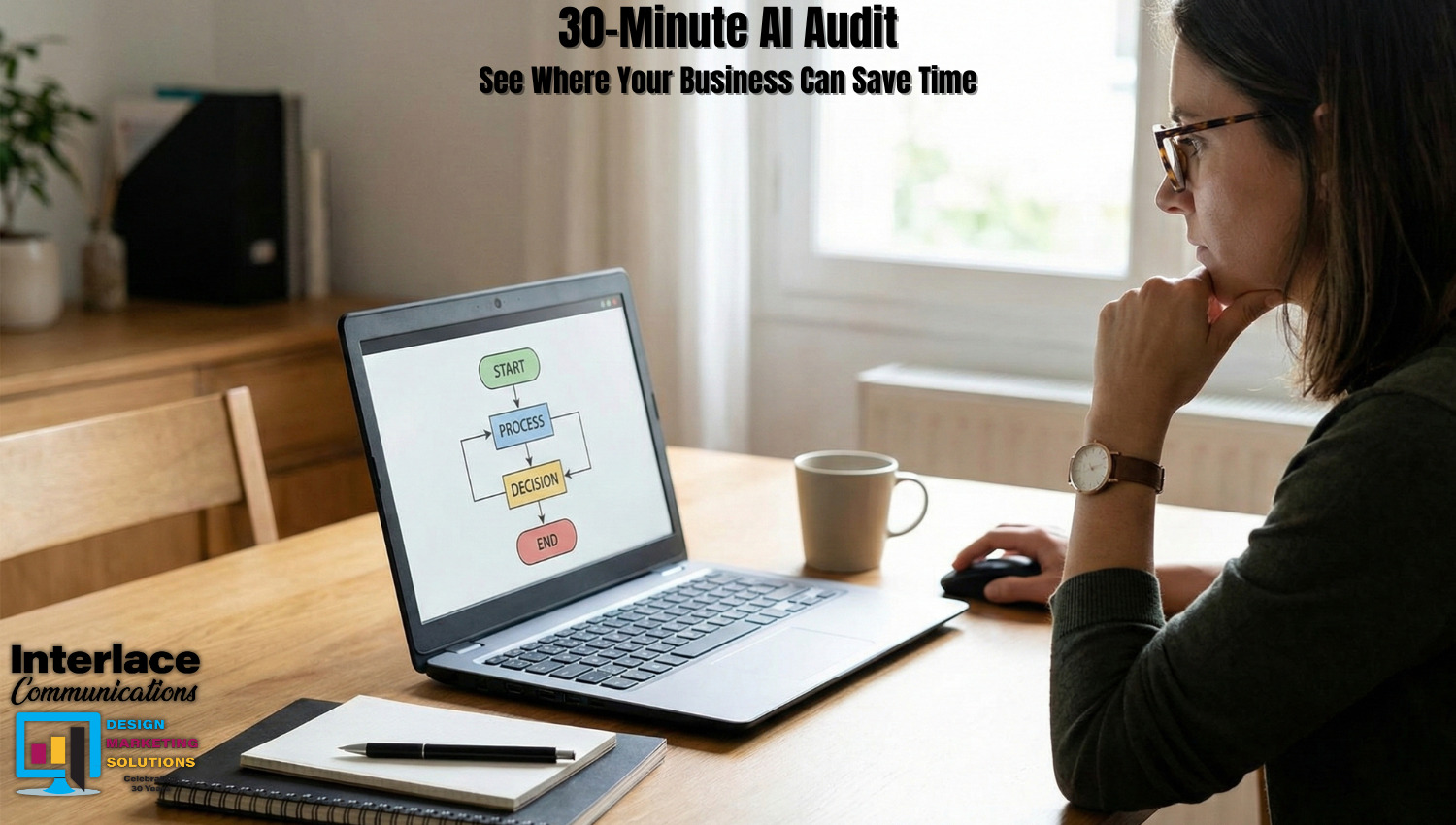
    Wondering how AI can actually help your business? In just 30 minutes, you can perform a quick AI readiness audit to identify opportunities, streamline processes, and prepare for 2026. This step-by-step guide makes it simple, actionable, and ensures you know exactly where Interlace can help you level up.

    Are You Missing AI Opportunities in Your Business?

    AI isn’t just a buzzword—it’s a tool that can save you time, reduce errors, and uncover growth opportunities. Yet many businesses only scratch the surface, unsure where to start. Before January 1, take 30 minutes to audit your business and identify where AI can make a real difference.

    Here’s a simple, December-friendly audit you can do yourself.

    5 Steps to a Quick AI Readiness Audit

    1. Map Your Processes

    Identify repetitive, time-consuming tasks across your business. Think invoicing, social media posting, customer follow-ups, or data entry.

    2. Identify Data Points

    AI thrives on data. List the information you already collect (customer emails, purchase histories, scheduling info) and note gaps.

    3. Assess Tools & Platforms

    Check which tools you’re currently using—are they AI-enabled, or could AI integrations make them smarter?

    4. Prioritize Impact

    Use a simple table to rank opportunities by effort and impact:

    Task Current Effort AI Potential Impact Score (1–10)
    Social Media Posts High High 9
    Customer Emails Medium Medium 7
    Data Entry High High 10
    Inventory Tracking Medium Low 5

    5. Plan Next Steps

    Decide which AI solutions to implement first. Low-effort, high-impact tasks are your sweet spot.

    Expert Insight from Alyse, ICI Owner:

    “Most businesses think AI is complicated, but it’s really about identifying small, practical opportunities first. A 30-minute audit can uncover multiple ways AI can save time and boost results before the year even starts.”

    FAQ: AI Readiness for Your Business

    Q: How do I know if my business is ready for AI?
    A: If you have repeatable processes, digital data, and clear goals, you’re already ready for a basic AI audit.

    Q: Do I need to hire a tech expert?
    A: Not for the audit. Simple audits can be done in 30 minutes, but a partner like Interlace can help with implementation.

    Q: What’s the biggest mistake businesses make with AI?
    A: Trying to do too much at once. Start small with high-impact tasks, then scale.

    Why Doing This Audit Now Matters

    December is the perfect time to prepare for the new year. By auditing your business for AI opportunities before January 1, you can start 2026 with a clear strategy, less manual work, and better business insights.

    Even a quick, 30-minute audit can reveal opportunities you didn’t know existed and partnering with Interlace ensures you go beyond basic AI, unlocking its full potential for your business.

    Next Steps for You

    Set a timer for 30 minutes this week, follow the steps above, and see what opportunities appear. If you want guidance on implementation or advanced AI solutions, contact Interlace Communications. We’ll turn your audit into action with mega prompts equipped to provide powerful insights and directions.

  • Who would you have on your Virtual Board of Advisors?

    Who would you have on your Virtual Board of Advisors?

    What is a Virtual AI Board of Advisors?

    A Virtual AI Board of Advisors is a carefully selected group of AI-powered experts trained to give guidance, ideas, answers, and decision support across your business. Think of it as a virtual think tank that works 24/7, never takes a vacation, and doesn’t argue over who gets the corner office. Businesses should have one because it accelerates planning, improves clarity, reduces overwhelm, and gives access to high-level strategy without hiring a team of executives. In 2026, companies leveraging a Virtual AI Board will move faster, spend smarter, and stay ahead of the curve.

    There’s a moment every business owner hits where they wish a panel of brilliant advisors would appear, serving wisdom like candy at a board meeting. Reality check: most of us are juggling employees, clients, deadlines… and that last cup of cold coffee.

    Here’s the good news: with today’s AI tools, you can stop flying solo. Build your own Virtual AI Board of Advisors, a custom set of AI advisors trained to support you in marketing, operations, leadership, and decision-making. With 2026 around the corner, now is the perfect time to get yours in place.

    Why Your 2026 Strategy Should Include AI Advisors

    Think of your AI Advisors as a team of virtual specialists who “think” exactly the way your business needs them to. Marketing, operations, client communication, workflow optimization — you name it, they have you covered. They won’t interrupt meetings, argue over strategy, or steal your parking spot.

    And while they don’t replace human judgment, they provide something priceless: years of experience and a wealth of knowledge.

    A few ways a Virtual AI Board of Advisors supports your business:

    • Helps you plan faster with less guesswork
    • Spots opportunities and risks you might miss
    • Provides consistent, reliable answers tailored to your business
    • Levels up your strategy without inflating payroll

    What Goes Into an Effective Virtual AI Board of Advisors?

    Here’s a practical list of the 5 Core Advisors Most Businesses Need for 2026:

    1. The Strategist – Your big-picture thinker for launches, campaigns, and growth planning.
    2. The Operations Optimizer – Documents processes, identifies bottlenecks, and builds efficient systems.
    3. The Marketing Maven – Generates messaging ideas, content plans, SEO insights, and competitor analysis.
    4. The Customer Experience Coach – Enhances service, retention, and communication touchpoints.
    5. The Financial Forecaster – Models scenarios, identifies smart investments, and keeps the spreadsheets from scaring you.

    A Visual Snapshot: How an AI Board of Advisors
    Moves Your Business Forward

    Area Old Model AI Board Model
    Strategy Slow, reactive planning Fast, proactive ideas
    Productivity Manual work, bottlenecks Automated support
    Decision-Making Gut instinct Data-backed clarity
    Innovation Occasional, inconsistent Continuous flow
    Cost High for human teams Low ongoing investment

    Notice how your coffee stays hot while your business moves faster. ☕🚀

    Expert Insight from Alyse Mitten

    “Having a Virtual Board of Advisors means you’re never learning and growing in isolation. Each AI advisor brings a different angle, and together, they help you process insights faster than you ever could alone. It’s like having a roundtable of experts who never stop researching, comparing, and connecting the dots so you can focus on what really matters,” says Alyse Mitten, Owner of Interlace Communications, Certified AI Consultant, and 30-year marketer.

    FAQ: Quick Answers That Go Beyond the Basics


    How many advisors should a small business start with?

    Most start with six to eight. Expand as your confidence and needs grow.

    Do I need technical skills to maintain a Virtual AI Board?

    Nope. Once properly configured, your advisors run with simple prompts in everyday language.

    Will a Virtual AI Board of Advisors actually save money and improve ROI?

    Yes! You get the opportunity of wise words from big names without the big fees. Having a virtual Elon Musk or Warren Buffett be on your Board of Advisors… one piece of advice from them is well worth the set up of your advisors.

    Key Takeaways

    Entering 2026 without support is like running a marathon without shoes.

    A well-built Virtual AI Board of Advisors can:

    • Strengthen your strategy
    • Speed up daily work
    • Keeps you ahead of competitors
    • Reduces overwhelm and decision fatigue
    • Lets you focus on growth, not firefighting

    Ready to Build Your Virtual Board of Advisors?

    Creating your AI advisors from scratch feels overwhelming. That’s ok. Because “Bob, my Board of Advisor Builder,  can help design a custom Virtual AI Board of Advisors tailored to how your business actually runs and needs help.

    Learn more about AI Solutions with Interlace Communications and make sure your business is ready to move faster, smarter, and cooler in 2026.

    Ending on a Personal Note…

    On a personal note, I have a virtual Board of Advisors for the Mid-Atlantic Community Papers Association where we help publishers of Community Papers and Shoppers provide sales, operation, and graphic design training and help. Our Board of Advisors consist of people who are passionate about our community papers. One of the advisors is Ryan Dohrn, the founder of the sales consulting firm Brain Swell Media, the author of the business book Selling Backwards. I love his training on email marketing and apply that knowledge to writing classified advertisements.

    Recently, I asked my “virtual” Ryan a question and confirmed with the “real” Ryan that the answer to the question would have been what he would have said. His words back to me in an email were, “I LOVE IT.”

  • 100 Small Businesses – 1 Big Honor – How Did Interlace Communications Make the CO—100 List?

    100 Small Businesses – 1 Big Honor – How Did Interlace Communications Make the CO—100 List?

    The CO—100 Small Business Forum is an annual event hosted by the U.S. Chamber of Commerce that honors the Top 100 small businesses in the nation for their innovation, adaptability, and impact. This year, Interlace Communications proudly joined that list, standing shoulder to shoulder with the best of the best in Washington, D.C.

    From Hamburg to the Hill: A Moment to Remember

    Washington, D.C. buzzed with excitement as the nation’s top entrepreneurs gathered under one roof for the CO—100 Small Business Forum. Representing Pennsylvania and the spirit of small-town innovation, Alyse Mitten, President of Interlace Communications, arrived ready to celebrate a milestone over 30 years in the making.

    From check-in to the first handshake, the experience felt first-class. The welcome reception opened with a cocktail party on Monday evening, where the honorees mingled like old friends. Conversations flowed easily among people who understood the late nights, the pivots, and the relentless drive it takes to grow something from nothing.

    Workshops, Wisdom, and Wow Moments

    Tuesday began with a warm welcome breakfast that set the tone for an unforgettable day. Four powerful workshops followed, each focused on strengthening and scaling small businesses through operations, innovation, and leadership. Every speaker brought something fresh and thought-provoking, leaving the audience inspired and energized.

    That evening, anticipation filled the air. The U.S. Chamber hosted a celebration dinner where the official winners were announced and a moving documentary about the honorees premiered. The night concluded with a lively afterparty, a well-deserved celebration of resilience, creativity, and community.

    Why This Recognition Matters

    Earning a place among the Top 100 Small Businesses in America is more than an award. It’s a testament to decades of integrity, reinvention, and commitment to helping others grow. Out of over 12,500 applicants nationwide, only 100 companies were chosen to represent excellence across industries, states, and years in business.

    Category Details
    Total Applicants 12,500+
    Honorees Selected 100
    States Represented 42
    Industries Included Marketing, Tech, Healthcare, Construction, Nonprofits, and more
    Years in Business (Range) 2 to 50+ years

    Each honoree was evaluated for innovation, community impact, customer service, and adaptability… qualities that have defined Interlace Communications since day one.

    “Being part of the CO—100 isn’t just recognition, it’s the gratitude to those businesses that lean on us to help them become successful and lead big changes.”
    — Alyse Mitten, President, Interlace Communications, Inc.

    Wednesday’s Farewell: Lessons to Last

    The final day brought another inspiring breakfast conversation with business leaders reflecting on the future of small business — real, raw, and energizing insights that lit up the room.

    Then came a highlight everyone will remember: Daymond John, founder of FUBU and star of Shark Tank, reminding us all that “Adaptability isn’t optional, it’s survival.”

    For Interlace Communications, that message wasn’t just motivational, it was personal. It’s the mindset that carried this team from Hamburg, Pennsylvania to the national stage in Washington, D.C.

    Why Working With a CO—100 Company Matters to You

    • 🏆 Nationally recognized excellence and innovation
    • 💡 Proven adaptability in a changing digital landscape
    • 🤝 A team invested in your long-term success
    • 🚀 Leadership that inspires both employees and partners

    More Than a Moment — A Movement

    Being recognized in the CO—100 isn’t just a celebration. It’s a reaffirmation of what Interlace Communications stands for: helping small businesses grow through smart strategy, trusted relationships, and the courage to evolve.

    From Hamburg to Washington and back again, this journey reminded us that success isn’t about size. It’s about impact.

    If the U.S. Chamber of Commerce trusts our innovation, imagine what we can do for your business?

    👉 Let’s Meet To Talk and grow together with a quick 15 minute meeting.  

    📞484-709-6564

  • Champion of Adaptability: Honoring Alyse Mitten on American Business Women’s Day

    Champion of Adaptability: Honoring Alyse Mitten on American Business Women’s Day

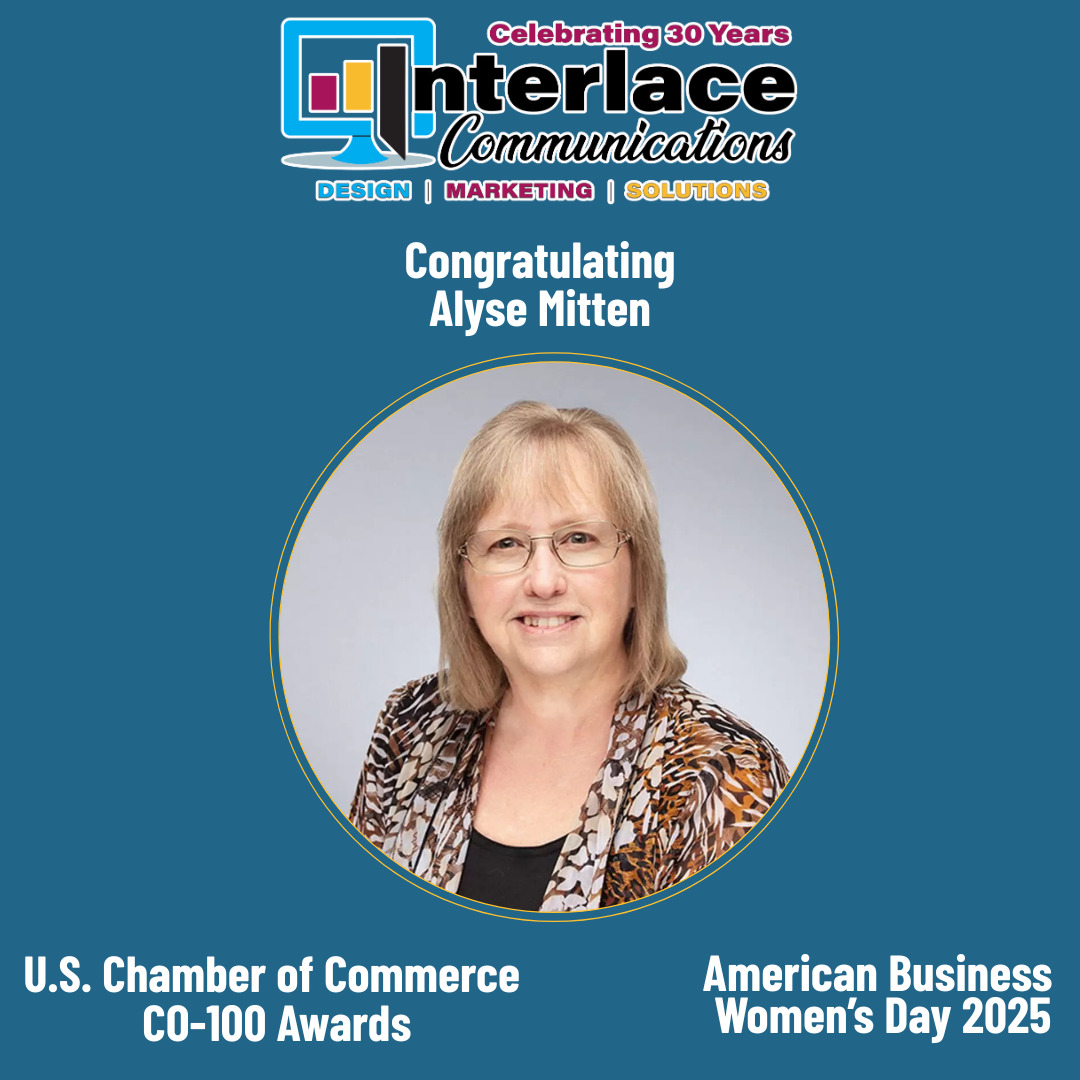
    On American Business Women’s Day 2025, we take a moment to recognize Interlace Communications, Inc.—a company founded by Alyse Mitten in 1995—that has been nationally honored as one of the U.S. Chamber of Commerce CO-100 “Champions of Adaptability.” The official celebration takes place on October 8, when Interlace Communications will be recognized in Washington, D.C., but today is the perfect time to pause and honor the innovation, resilience, and commitment to helping businesses grow that earned this award.

    Why Does American Business Women’s Day Matter?

    Every September 22, American Business Women’s Day celebrates the achievements and contributions of women entrepreneurs and leaders across the country. It’s a day that honors resilience, creativity, and the countless ways women shape both the economy and their communities.

    This year, the day carries special meaning here in Berks County, PA. Interlace Communications, Inc.—founded by Alyse Mitten in 1995—has shown what it means to adapt and endure. From its early days in association management to building websites during the dot-com shift, and later embracing social media and now AI, the company has continually adjusted to keep businesses connected and thriving. That ability to pivot and sustain through decades of change is why Interlace Communications has been named one of the U.S. Chamber of Commerce’s CO-100 “Champions of Adaptability.” Today is the perfect moment to honor not only this national recognition, but also the long journey of innovation and reinvention that made it possible.

    What Is the U.S. Chamber CO-100 Award?

    The U.S. Chamber of Commerce CO-100 Awards shine a spotlight on America’s Top 100 small businesses, chosen from more than 12,500 applicants nationwide. These awards recognize companies that embody innovation, growth, and resilience in a changing economy.

    Earning a place in the Top 100 is a rare distinction. To be further recognized as a Champion of Adaptability means Alyse and Interlace Communications didn’t just survive shifting times—they thrived, setting an example for others to follow.

    Who Is Alyse Mitten and Why Was She Honored?

    From founding Interlace Communications in 1995 to guiding it through decades of technological and economic change, Alyse has built her career on flexibility, integrity, and community service.

    • When the 2008 recession shook small businesses, she pivoted from association management into website design and digital marketing.
    • When the pandemic disrupted operations, she quickly provided remote-friendly marketing solutions to keep clients connected to their customers.
    • Today, she’s pioneering AI-first marketing and printing solutions, helping small businesses harness the latest technology without losing their personal touch.

    What truly sets Alyse apart is her heart. Clients know that when they work with Interlace, they’re not just getting a service—they’re gaining a partner who listens, understands, and genuinely cares about their success.

    “I’ve worked for Alyse for more than 10 years, since I was a high school intern and I’ve always been awed by her ability to adapt. When I first joined the team, she was already ahead of the game with mobile-friendly solutions. Now she’s leading the way in AI and marketing innovations. What impressed me most was learning about her early career. She once took a coding class to stay informed on the latest tech, and ended up teaching not only herself, but the teacher as well! Alyse is always learning, always adapting.”
    — Annie Crider, Longtime Interlace Employee

    5 Ways Alyse Embodies the “Champion of Adaptability” Award

    ✔️ Visionary Leadership – Sees possibilities long before they’re mainstream, positioning    clients for success.
    ✔️ Integrity First – Builds long-term trust by always prioritizing what’s best for clients.
    ✔️ Community Impact – Invests deeply in local chambers, associations, and nonprofits.
    ✔️ Innovation with AI – Brings practical AI-driven tools to small businesses.
    ✔️ Resilience – Thrives through economic shifts and industry changes, inspiring others to do   the same.

    Career Milestones That Tell the Story

    Here are some of the defining moments that highlight Alyse’s adaptability and vision:

    Year Milestone Impact
    1995 Founded Interlace Communications Brought professional marketing support to small/local businesses
    1999 First Website Launch Helped associations establish an online presence early
    2008 Pivot to Digital Transitioned into web design & social media during the recession
    2020 Pandemic Response Equipped businesses with virtual marketing & online growth strategies
    2023–25 AI Transformation Positioned Interlace as an AI-first marketing & printing agency
    2025 U.S. Chamber CO-100 Recognition Named “Champion of Adaptability,” one of America’s Top 100 small businesses


    Why Does This Recognition Matter on American Business Women’s Day?

    American Business Women’s Day isn’t just about honoring individual success—it’s about spotlighting the ripple effect women leaders create. Alyse’s recognition shines a national light on both Hamburg, PA and the Berks County business community, proving that small-town businesses can make a big impact.

    Her journey shows that adaptability isn’t simply about changing with the times—it’s about leading with courage, lifting others along the way, and turning challenges into opportunities.

    Final Thoughts

    This American Business Women’s Day, we celebrate all women in business—and especially Alyse Mitten, whose adaptability, vision, and integrity have earned her national recognition as a CO-100 Champion of Adaptability.

    Her story reminds us that small businesses can thrive no matter the challenge when they lead with people, purpose, and persistence.

    👉 Ready to work with a Champion of Adaptability? Connect with Interlace Communications today for marketing, printing, and AI-powered solutions that help your business grow.


    Share this article:

    [DISPLAY_ULTIMATE_SOCIAL_ICONS]

  • 💡 5 Surprising Lessons from Expanding into Walk-In Printing Services in Hamburg

    💡 5 Surprising Lessons from Expanding into Walk-In Printing Services in Hamburg

    Q: What are the benefits of walk-in printing services at Interlace Communications?
    A: Walk-in printing makes it easy to get fast copies, place orders, or send faxes on the spot. At Interlace Communications, expanding into walk-in services has streamlined business printing and built stronger community connections through personal, face-to-face support.

    Ever wonder what really happens “behind the counter”?

    Spoiler: It’s more than ink and paper. Since opening our walk-in print shop, we’ve learned lessons that surprised even us—and reshaped how we connect with our community.

    1. Small Jobs Pack a Big Punch

    Banner runs and bulk orders keep the machines busy, but the single faxes and quick copies matter most—legal papers, job applications, medical forms. These “small” jobs carry big weight, and helping in a pinch is the part that sticks with us.

    2. Community Shows Up—Literally

    Walk-ins brought us face-to-face with people we might never have met otherwise: local churches printing their weekly programs, small business owners needing flyers yesterday, and special projects tied to community events.

    (Fun tie-in: This year, we even helped with projects for the Taste of Hamburg-er Festival—a true “local flavor” moment.)

    3. Teamwork in Real Time

    Behind the counter, it’s all hands on deck. One person handles copies, another answers design questions, someone else sends faxes while phones are ringing. It’s fast-paced, a little chaotic, and honestly? Fun. Teamwork keeps everything moving.

    4. Family Ink Runs Deep

    The Windsor Press is “in the family,” so our expansion wasn’t a cold start. With George Mitten sharing decades of print wisdom alongside our marketing team, customers get the best of both worlds—traditional print expertise blended with modern digital solutions.

    5. Printing = Connection

    Walk-ins aren’t just about paper—they’re about trust. Customers know when they hand us something important, it’ll get done right.

    Take faxing, for example. Many need to send documents to the Department of Human Services, but their lines are always busy. Instead of stressing at home, customers leave documents with us. We keep dialing until it goes through and hand back a confirmation slip. That peace of mind—that “it’s really taken care of” feeling—is why they come back.

    📌 Quick Counter Notes

    • Fun Fact: Faxing is still our #1 most-requested service. Some official documents just work better the old-fashioned way.
    • Snapshot: Imagine this: one customer’s fax finally clears, another’s flyers are hot off the press, and a church’s weekly program is ready—all while our team balances marketing deadlines. Busy? Absolutely. But we wouldn’t trade it.

    Closing Thought

    Expanding into walk-in printing hasn’t just been a business move—it’s been a community move. It keeps us grounded, connected, and learning every day.

    👉 Need something printed, copied, or faxed today? Stop by the front counter of Interlace Communications in Hamburg, PA —we’re here to help (and yes, we’ll keep dialing until that fax really goes through).  Learn more about us at Interlace Communications.

  • AI Resistance: What is AI? How can AI help me? Is AI worth the risk?

    AI Resistance: What is AI? How can AI help me? Is AI worth the risk?

    AI is the big, new thing in technology and it’s having an impact on all types of people. Businesses are moving to use AI in the workplace. Individuals are using it for everything from making cat images to aiding them in their own work. But is this a good thing? AI Resistance is about the ways AI can be used in daily life or the workplace, the risks that come from using AI, and practical ways of utilizing AI as a tool.

    AI is a Tool

    A key message in AI Resistance is that AI is only a tool, so it helps or harms depending on how the tool is used. Learn what to do and what to avoid when using AI, and you can start benefiting from it like the AI pros.

    Whether you are a cautious business owner or a skeptical individual, the book AI Resistance by Alyse Mitten is for you.

    [su_button url=”https://mybuild.iciconnect.com/ai-resistance-book/” target=”blank” style=”flat” background=”#AB175D” color=”#ffffff” size=”6″ center=”yes” radius=”5″ icon=”icon: shopping-cart”]Order Your Copy[/su_button]


    AI Resistance as described by Alyse:

    “This book is for the cautious, the curious, and the thoughtful.

    It’s for the leader who isn’t sure how to start — or whether they should start at all.

    It’s for the individual who sees change coming and wants to meet it on their own terms — with clarity, confidence, and integrity.

    Inside these pages, you won’t find hype. You’ll find honest conversations, practical strategies — and a gentle reminder: AI isn’t here to replace you.

    It’s here to help you do what you do best — even better.

    Maybe you picked up this book on your own. Or maybe someone already using AI gave it to you — because they realize it’s just a tool. Nothing more. Nothing less.

    Welcome to your next step. You don’t have to run. You don’t have to fear. You just have to stay open (just a little bit) — and begin.”


    Chapters include:

    1. The AIs We Trust
    2. AI—From Concept to Possibility
    3. Generative AI: The Wild, Wild West
    4. Moving Forward…Overcoming Misconceptions
    5. Junk In, Junk Out – The Reason for Lousy Results
    6. Real-Life Success Stories with AI
    7. Wrapping It All Up – Your AI Advantage
    8. Opening the Door to What’s Next

    [su_button url=”https://mybuild.iciconnect.com/ai-resistance-book/” target=”blank” style=”flat” background=”#AB175D” color=”#ffffff” size=”6″ center=”yes” radius=”5″ icon=”icon: shopping-cart”]Order Your Copy[/su_button]

  • What’s It Really Like to Work with Interlace Communications?

    What’s It Really Like to Work with Interlace Communications?

    Ever wonder what it’s actually like behind the scenes at a local marketing and printing company?
    If you’ve never worked with us before, you might be picturing a big agency or a faceless print shop. But the ICI process is personal, thoughtful, and completely grounded in real relationships—with over 30 years of experience behind it.


    The ICI process is a personalized approach to digital marketing, website management, and commercial printing that combines extensive experiences. Our family-run team provides hands-on service to support local businesses in Berks, Schuylkill, Lehigh, and Bucks counties and, frankly, beyond. From walk-ins to full-service marketing campaigns, every project is handled with care—and a lot of creativity.

    A Family Business with Heart (and Strategy)

    The driving force behind Interlace Communications is Alyse Mitten, who launched the business over three decades ago. What started as association management has grown into a powerhouse for local businesses—offering everything from website design to business cards, social media campaigns, and commercial printing services.

    Alyse isn’t just the founder—she’s the spark that keeps things moving. With years of hands-on training in marketing from the best of the best mentors and a genuine love for helping people grow their businesses, she’s been leading the team and guiding clients since day one. She is the one who challenges conventional thinking, proposes innovative yet effective marketing strategies, identifies opportunities that others overlook, and spearheads the transition to an AI-focused approach to operations. Her mix of creative thinking and practical know-how keeps us all pushing forward—without ever losing sight of what matters most: helping people grow.

    The ICI process isn’t just about tools—it’s about people. And many of those people are family.

    Meet the Team Behind the Magic

    Vicki, Alyse’s oldest daughter, is our vice president in charge of finances and operations. What that means is she manages the billing department and keeps everything organized (and we mean everything). She also oversees many of the commercial print jobs—yes, the ones you get with perfect folds, clean cuts, and quick turnarounds. Most print shops you see are cluttered with stacks of paper, unclaimed boxes, and snippets of paper scattered around. Just stop by sometime. You’ll really wonder, do they really print here? The results clearly demonstrate that we are a busy shop.

    Kasey, the youngest daughter, is our in-house graphic designer and a total creative powerhouse. From business cards to brochures, she brings fresh, on-brand designs to life. She also trained Erin (hi, that’s me!) in how to build email campaigns and handle social media with strategy—not just speed.

    Kasey pops in regularly to keep things running smoothly on the creative side of our print projects. Often, she surprises us with delicious treats that she baked. Ask us about her cheesecake cupcakes.

    Then there’s Annie, our Website Mechanic. Why “mechanic?” Because websites, like cars, require maintenance, updates, and the occasional tune-up. Annie knows how to keep your site running, clean, and ready for whatever tech updates Google throws our way, and there are plenty lately. Whether it’s a quick fix or a full rebuild, she keeps your digital engine humming.

    Lastly, there’s me, Erin. I am the first face you’ll usually see when you walk in the door. I manage light print and copy jobs, faxing, and front counter support. But I also handle our email campaigns, social media, and blog content (like this one!). My job is to make sure you feel supported, heard, and ready to tackle your next big idea.

    So, what is the ICI process?

    We could bullet this all out, but the truth is—it’s a flow. A rhythm. A conversation.

    It might start with a walk-in asking, “Can I fax this here?” and lead to a new rack card design for your business. Or maybe you come in looking for postcards, and we help you create a QR code for your postcard that goes to your website, and then we set up an email sequence from the postcard to get potential clients to your website.

    The ICI process is great because we work with you where you are and how you want to move forward. When ready, we help to move the conversation in different, creative, innovative ways to help provide even more ways to improve.

    Why It Works (And Why People Keep Coming Back)

    We’re not a chain. We’re not an online-only printer. We’re a local team that knows and works in your neighborhood, understands your audience, and answers the phone when you call.

    Our team blends old-school know-how with new-school tools. Alyse is a Certified AI Consultant (yep, she’s super geeky about this stuff and loves every minute of it), and Erin (yes, me), I’m not far behind with training to be certified. We lean on AI and automation where it actually helps. We view AI as merely a tool. A smart one, sure, but still a tool. People? We remain at the core of everything we do. No robots here replacing any of us anytime soon. Well, maybe we’ll have one of those cute ones that was on “America’s Got Talent” the other night. (Alyse thinks they would be cute to have around).

    The ICI process ultimately revolves around trust and transparency. You bring us your ideas, your goals, or sometimes just your messy to-do list—and we help bring it all together.

    Come See the Process for Yourself

    Whether you’re launching a new business, updating your website, needing 500 flyers printed yesterday, or just wanting to make your marketing feel more like “you”—we’re here for it.

    📍 Stop by our Hamburg location or plan a quick 15-minute call to share your ideas with us. We’d love to share with you more about how the ICI process can help your business.


    Share this article:

    [DISPLAY_ULTIMATE_SOCIAL_ICONS]

  • Cloning Myself? Why am I Hesitant—and Why am I Still Exploring HeyGen Studios to convince myself?

    Cloning Myself? Why am I Hesitant—and Why am I Still Exploring HeyGen Studios to convince myself?

    By Alyse Mitten, Interlace Communications, Editor

    When our AI Trainer introduced this idea during my certification as an AI Consultant, I had thoughts then but only briefly. Well, today, I want to bring you into the conversation.

    You may or may not have heard of HeyGen Studios. They’re one of the leading platforms right now offering AI-generated video avatars—some that are avatars available to use and then avatars that look and sound like you, reading scripts you’ve written, and, to boot, in dozens of languages, with facial expressions, gestures, and even wardrobe changes. Pretty amazing, right?

    And yet… I’ve been hesitant.

    Not because I don’t see the value. In fact, that’s the very tension I’m sitting with. I do see the value. I just also see the questions. And that’s what this article is about.

    The Temptation to Clone Myself

    As an AI consultant, speaker, and business owner, I’m constantly creating—writing scripts, drafting blogs (like this one), recording videos, speaking at events. But there are only so many hours in the day. I often catch myself thinking, “If only I could be in two places at once.”

    That’s the exact promise of cloning yourself with a platform like HeyGen: record a short training or welcome video once, and let your AI self deliver the message whenever and wherever it’s needed. Want to scale your workshops? Send a personalized message to new leads? Offer multilingual content to reach new audiences? HeyGen makes it look easy and, frankly–having created videos with it, it is easy.

    I created a few videos using their default avatar options, and honestly? I didn’t mind it. The result was clean, professional, and got the message across without me needing to set up lights, do my hair, or re-record five takes.

    Imagine, the idea of cloning myself is incredibly appealing. I could take the material I’ve been pouring myself into—the content that lives in notebooks, slide decks, and half-drafted blog posts—and give it a voice and face, even on days I don’t have time to get camera-ready.

    The truth is, I’m no stranger to video creation. I enjoy the process. I’ve spent the last 3 years following influencers like Mark Harbert to learn how to help clients craft visual content that connects. So using HeyGen in a practical way just made sense—and it saves time.

    But here’s what is ok with me: using a generic avatar just feels very different from cloning myself. There’s a gap between “using an avatar” and “becoming the avatar.” That’s the line I’m hesitant to cross. Once it’s me—my face, my voice, my mannerisms—that’s no longer a stand-in, it’s my digital twin. And that comes with a deeper level of responsibility and care. I can’t shrug off a bad script or a mispronunciation. It’s not “the AI’s” mistake anymore. It’s mine.

    So even though I’ve dipped my toes into the water, cloning myself still feels like a bigger leap. One that I want to prepare for thoughtfully.


    Let’s look at the Pros and Cons of this.

    If you’re feeling the same hesitation, you’re not alone. Some of the most common struggles people have when considering avatar cloning include:

    1. Fear of Losing Human Touch
      There’s something powerful about showing up—flaws, pauses, and all. People connect with people. And the idea of handing that over to an avatar can feel… detached.
    2. Worry About Misuse
      Once your image and voice are cloned, how do you ensure it’s only being used the way you intended? What if someone else gains access to it—or edits it without your permission?
    3. Concern About Brand Integrity
      Your tone, phrasing, even facial expressions are part of your brand. A poorly rendered avatar could water that down, or worse, damage the trust you’ve built.
    4. Ethical or Spiritual Reservations
      For some, the thought of replicating their likeness feels unnatural or even unsettling. It raises bigger questions about identity and presence.

    These are all real concerns, and they shouldn’t be dismissed in the rush to adopt shiny new tech.


    Now, to the pros of cloning:

    That said, there’s a reason I’m still exploring this. Because the benefits are real—and in some cases, powerful.

    1. Reach More People, More Consistently
      Your AI avatar can deliver a consistent message, even when you’re unavailable. That’s a game-changer for client onboarding, course creation, and lead nurturing.
    2. Save Time and Energy
      Not every message needs a fresh recording. Sometimes you just need to say the same thing—well—over and over again. This is where automation shines.
    3. Expand Your Accessibility
      With multilingual and subtitled videos, you can open your message to broader, more diverse audiences.
    4. Stay Top of Mind
      You can maintain a presence on camera even during busy seasons—without compromising on quality or exhausting yourself.

    I don’t know about you, but there’s a bit more buy in by me.

    My Commitment Moving Forward

    I’ve decided that before I ever hit “clone,” I’m going to learn everything I can about HeyGen Studios—how it works, where it shines, and what to watch out for.

    I want to understand the creative controls, the security protocols, the export settings. I want to test what it feels like to write a script for myself versus writing for my avatar. I want to see how the AI handles pauses, warmth, humor. And then—and only then—will I decide how to move forward.

    Because in the end, this isn’t just about saving time. It’s about staying aligned—with my voice, my values, and my community.


    Wrapping It All Up

    Should you clone yourself? Maybe. Maybe not. But the more important question is this:

    What do you want your message to do—when you’re not in the room?

    That’s the question I’m sitting with. And as I explore this next chapter, I’ll be sharing what I learn—openly, honestly, and in my own voice (AI or otherwise).

    Let’s stay curious together.

    Curious about using HeyGen or other AI tools for your business? Let’s chat. I’d love to share what I’m learning and hear what you’re exploring too.


    Follow Us:

    [DISPLAY_ULTIMATE_SOCIAL_ICONS]

  • What Are the Top Print Essentials for Your Business?

    What Are the Top Print Essentials for Your Business?

    In a world where screens dominate, there’s something surprisingly powerful about holding a well-designed print piece in your hands. Whether it’s the weight of a business card or the bold pop of a banner, print isn’t just alive—it’s making bold statements every day. I’m excited to share a new perspective on print and how your business can use it in ways that are anything but boring.

    Instead of a long-winded list, let’s walk through the print essentials — reimagined as The Print Power Pack your business shouldn’t leave behind.

    🧰 Your Print Power Pack: What’s In It?

    🪪 The Pocket Opener
    Think: Business cards. Still one of the most direct and personal ways to say, “Here’s who I am.” It’s the handshake that makes a statement long after your meeting.

    📄 The Quick Grab
    Flyers and brochures are the visual elevator pitch. Whether stacked at a front desk or handed out at events, they spark curiosity and invite action.

    ✉️ The Signature Statement
    Custom letterhead and envelopes show you care about the details. They’re your brand’s “thank you” and “nice to meet you” all in one.

    📁 The Professional Polish
    Presentation folders? These are for the meetings that matter. Show up with materials tucked neatly inside, and you’ve already won half the room.

    🪧 The Look-At-Me Launcher
    Signage and banners shout your message where it counts—trade shows, storefronts, community fairs. Bonus: Weatherproof ones keep on shouting through rain or shine.

    📬 The Mailbox Moment
    Postcards and direct mail pieces slice through the digital noise. Nothing says “I’m thinking of you” like a message delivered straight to someone’s mailbox.

    🖊️ The Everyday Reminder
    Promotional products—pens, notepads, magnets—these are the slow-burn heroes. They live on desks, in drawers, and in your customers’ daily routines.

    🧾 The Operational Touchpoint
    Invoices and forms don’t have to be bland. Branded paperwork keeps your business looking buttoned-up, even in the back office.

    📘 The Legacy Builder
    Printed annual reports and publications give you a platform to showcase growth, stories, and impact—all wrapped in tangible credibility.

    Why It Matters More Than Ever

    Every one of these print essentials has a job to do—and when they’re done right, they work harder than you think. They create emotional impact, build recognition, and offer tactile trust that digital can’t always replicate.

    And, when your print and digital efforts align? That’s brand synergy in motion.

    One Team, One Brand Voice

    At Interlace Communications, we don’t just design print—we understand what makes it work. And now that we’ve added commercial printing to our services, you can count on us to carry your brand seamlessly from screen to paper to storefront.

    From brainstorming your ideas to delivery, everything stays under one roof—with a trusted partner who meets your standards when needed. You get convenience, consistency, and guidance at every step.

    ✨ Want to make print part of your brand’s story again?

    Whether you need a refresh on the classics or something custom and clever, we’re here to help you leave a lasting impression. Let’s grab a quick 15-minute meeting to chat.

  • Why Is Print Marketing Still Powerful in the Digital Age?

    Why Is Print Marketing Still Powerful in the Digital Age?

    Print marketing remains relevant in the digital age because it creates tangible connections with customers, boosts brand credibility, and complements digital strategies through integrated approaches like QR codes. Physical materials like brochures and business cards continue to drive engagement through their tangibility, memorability, and ability to reach audiences regardless of digital access.

    Can Print Really Thrive in Our Digital World?

    Today, I’m excited to explore a question that’s popping up more and more: Does print still matter in our increasingly digital lives? From my experience, the answer isn’t just yes—it’s absolutely!

    Let me share why combining the tactile charm of print with the dynamic power of digital creates a synergy that’s truly remarkable. I’ve seen firsthand, alongside clients and peers, how bridging these two worlds can make all the difference.

    The Tangible Power of Print

    Print materials offer a unique advantage: they’re tangible. Think about the feeling of handing someone a beautifully designed business card. It’s not just about exchanging information—it’s a physical representation of your professionalism, personality, and attention to detail.

    Imagine brochures displayed in offices or handed out at events. People interact with your content at their own pace—no screens or Wi-Fi required. It’s personal, memorable, and creates lasting impressions through touch, sight, and even smell. Yes, smell! Freshly printed materials can truly imprint your brand in someone’s memory.

    QR Codes: Bridging the Gap Between Print and Digital

    One of the most exciting tools I’ve introduced clients to lately is the humble QR code. These little squares have revolutionized print materials by instantly linking users to:

    – Websites and landing pages
    – Exclusive promotions
    – Engaging video content
    – Digital catalogs and portfolios
    – Social media profiles
    – Immediate contact details

    Picture handing someone your business card. With a quick scan, they don’t just get your contact information—they access your entire digital world. That’s powerful!

    Building Trust and Credibility

    Let’s talk about trust. Print inherently carries credibility. Investing in high-quality print materials signals to your audience that you’re established, reliable, and committed to excellence.

    Ever noticed how a thoughtfully crafted direct mail piece can catch your attention amid the clutter of emails? Clients frequently share how these tangible interactions help them stand out, creating genuine moments of connection and trust.

    Reaching Beyond Digital Boundaries

    Digital fatigue is real, and print provides a refreshing alternative. Here’s who especially benefits:

    – Older demographics comfortable with traditional media
    – Communities with limited digital connectivity
    – People experiencing screen fatigue
    – Professionals in environments restricting digital device usage

    Print ensures your message reaches everyone, everywhere.

    Integrating Print and Digital for Maximum Impact

    The secret isn’t choosing print or digital—it’s integrating both strategically. Here’s how savvy businesses are doing it:

    – Direct mail with QR codes leading to personalized digital experiences
    – Business cards connecting to online portfolios or demonstration videos
    – Catalogs linking directly to up-to-date digital inventory
    – In-store print signage encouraging digital interactions
    – Newsletters offering exclusive online content through QR codes

    Measuring Print’s Success

    One past challenge with print was tracking its effectiveness. Thankfully, those days are behind us! Using QR codes, dedicated landing pages, or unique contact numbers makes tracking interactions straightforward and insightful, helping you continuously refine and improve your strategies.

    Ready to Harness the Best of Both Worlds?

    At Interlace Communications, we help businesses combine print and digital strategies smoothly, boosting their impact with customers at every step. If this sounds interesting, let’s talk about creating clear, effective print marketing your audience will love.

    Print isn’t old-fashioned—it’s changing for the better. When paired with digital tools, incredible things happen!

  • Customer Inventory Website

    Customer Inventory Website

    Custom Inventory System

    A unique solution for inventory management


    1. Home

    2. /
    3. Customer Inventory Website

    Business Type : Contractors, builders, and businesses that manage their own tool inventory

    [siteorigin_widget class=”SiteOrigin_Widget_Image_Widget”][/siteorigin_widget]

    how they came to us

    Inefficient and manual inventory

    A contracting client of ours approached us with a problem: they were losing their tool inventory at a higher rate than they should. They found their current, all manual process of distributing and returning tools for jobs lead to some chaos. Some employees misplaced tools and forgot to notify anybody, some would give the tools they took to another employee who would take it on a job it wasn’t expected to be on, and some thought they returned a tool, only to have forgotten it was still in the truck. Others could have used them for their own personal purposes.

    Overall, the process allowed for too much to get lost, and it often took a long time for management to find out that the tool was missing or never returned. Even worse, when they investigated where the tool had gone, the search often became a he-said-she-said of who lent it to whom and where they left it and who found it lying around.

    our approach

    Custom management of tools

    Our approach to the tool request process focused on making the first half of tool usage easy with an inventory management website. The second half of the process would be more manual to reduce the amount of inventory loss they had.

    First, we built a bare-bones version of an e-shop for them. This would be the structure that would allow them to both automatically request tools and manually go in and mark tools as returned. All tools would need to be part of this system and marked with their SKU or item number. They would be set at $0 because the purpose was to track, not buy. The checkout system was also modified to remove most of the normal e-shop requirements and include more useful fields such as where the tool was being brought and who was in charge of the job. This information was useful going forward in ensuring the person who requested the tool and the person in charge of the job were clearly marked and known. If any tools ended up missing, it was easy to know exactly who last had it at which job shortly after it should have been returned.

    The largest part of the project was the importing process. Because they had hundreds of tools, some with variations within each tool type, we utilized a built-in import process. We assisted the client in creating a spreadsheet that would allow them to add, remove, and change info, then import the sheet into the website to bulk-update or bulk-add items. We also created a lengthy document with step-by-step instructions for them to use as a guide.

    Finally, the process to return tools to the shop was kept manual, requiring the manager to log in and mark the tool as back in stock on the site. This was kept as manual as possible because it prevents employees from simply marking a tool returned when it was not, and it tracks who makes edits to the tools on the website, deterring any manager from lying about the tool being returned. This level of accountability helped reduce any confusion, which led to less tool losses.

    [siteorigin_widget class=”SiteOrigin_Widget_Image_Widget”][/siteorigin_widget]
    [siteorigin_widget class=”SiteOrigin_Widget_Image_Widget”][/siteorigin_widget]

    the results

    Easier employee experiences & less inventory loss

    With this blended automatic/manual inventory management system, the contractor company successfully reduced the amount of inventory loss while making it easier and faster for employees to request tools.

    If you are interested in having an inventory management system like this one, give us a call to receive an account to explore the website.

    484.709.6564

    The team at ICI would love to help you with your next project too!

    Here’s how you can start the conversation:

  • How Can You Optimize Your Blogs for Both SEO and AEO?

    How Can You Optimize Your Blogs for Both SEO and AEO?

    Whether you’re running a B2B or B2C company, are you wondering how to effectively optimize your content for both Search Engine Optimization (SEO) and the new Answer Engine Optimization (AEO)? The key lies in creating high-quality, targeted content that not only ranks well in search engines but also provides direct answers to user queries, particularly as AI-powered platforms become increasingly prevalent in our digital landscape.

    To optimize blogs for SEO and AEO, create high-quality, targeted content that answers user queries directly. Focus on keyword research, use structured headings, and aim for featured snippets. Additionally, prioritize conversational language for voice search, use schema markup, and update content regularly for relevance. By balancing SEO’s comprehensive approach with AEO’s focus on direct answers, your content can rank higher in search engines and AI-driven platforms alike.

    Understanding AEO: The Next Frontier in Digital Marketing

    Answer Engine Optimization (AEO) is about creating content that directly answers user queries, optimized for AI-powered platforms and voice assistants. It’s an evolution of SEO that focuses on providing immediate, concise answers to user questions.

    Now, let’s look into how you can create content that satisfies both SEO and AEO requirements for your business.

    First things first: What’s AEO?

    AEO stands for Answer Engine Optimization. It’s all about optimizing your content to provide direct answers to user queries, especially for AI-powered platforms and voice assistants. Think of it as SEO’s cooler, more direct little sibling.

    When I first heard about AEO in a recent podcast, my ears perked up. I’ve been curious with how to be found on AI platforms like Chat, Gemini, Claude, and Perplexity. I’m not treating this like another buzzword. No sir, this is going to be a game-changer in how we approach content creation. In fact, our latest blogs have all been created using the strategies provided for dual optimization.

    Now, you might be wondering, “Do I really need to worry about both SEO and AEO?” The short answer is: absolutely!

    Here’s why:

    SEO ensures your content ranks well in traditional search results, driving organic traffic to your site. AEO, on the other hand, helps your content appear in featured snippets, voice search results, and AI-generated answers. You do this right, and your blogs and website content is going to be a powerhouse duo that can skyrocket your online visibility.

    So, how do we create content that satisfies both SEO and AEO? Let’s break it down:

    1) First and foremost, Know Your Audience Avatar. 

    Do you know what makes your client/customer click? What are their pains and frustrations? What do they worry about that keeps them awake at night?
    What are their goals and desires? What are their dreams and aspirations?

    Don’t know these answers? Find out by running one of my favorite prompts to identify your avatar. 

    2) Start with Killer Keyword Research

    This is the foundation of both SEO and AEO. But don’t just focus on short, generic keywords. Look for long-tail keywords and, more importantly, questions your audience is asking. I always say, ‘Don’t guess what your audience wants to know – find out!’ Tools like AnswerThePublic are goldmines for question-based keywords. Just an FYI, a long-tail keyword is a phrase of 3 to 5 words specific to your business.

    3) Structure Your Content Smartly

    For SEO, use clear headings (H1, H2, H3) to organize your content. For AEO, structure your content to directly answer specific questions. A great trick is to use a question as your H2 and provide a concise answer immediately after. Be careful to never use more than one H1 on a page. More than one will adversely affect your ranking on Google.

    4) Optimize for Featured Snippets

    Featured snippets are the holy grail of AEO. To increase your chances of landing one:

    • Use clear, concise language
    • Provide direct answers to questions
    • Use bullet points or numbered lists where appropriate
    • Include relevant data and statistics

    5) Create In-Depth, Authoritative Content

    While AEO focuses on direct answers, don’t forget the depth that SEO requires. Expand on your topics to demonstrate expertise and authority. Remember my lunch and learn about E.E.A.T.? Remember, you’re not just answering a question—you’re becoming the go-to resource in your niche.

    6) Implement Schema Markup

    Schema markup is like a secret handshake with search engines. It helps them understand your content better, which is crucial for both SEO and AEO. See how the tools we use for SEO complement AEO, too.

    7) Focus on User Intent

    Understanding why people are searching for specific topics is key. Are they looking for information? Trying to make a purchase? Tailor your content to address these needs directly. It’s important to pay attention and ask questions. Be curious about your client’s needs.

    8) Optimize for Voice Search

    With the rise of voice assistants, optimizing for voice search is crucial for AEO. Use natural, conversational language and focus on answering questions clearly and concisely.

    9) Keep It Fresh

    Regularly update your content to ensure it remains relevant and accurate. This is important for both SEO rankings and AEO accuracy.

    10) Don’t Forget Technical SEO

    While we’re focusing on content, don’t neglect technical SEO aspects like page speed, mobile-friendliness, and secure connections (HTTPS). These factors affect both SEO rankings and AEO performance.

    11) Create Multi-Format Content

    Don’t limit yourself to text. Incorporate images, videos, and infographics. This not only enhances the user experience but also increases your chances of appearing in various search features.

    By implementing these strategies, you’ll create content that’s optimized for both traditional search engines and emerging answer engines. It’s a win-win!

    Remember, the key is to strike a balance. You want to provide quick, direct answers for AEO while still offering comprehensive, valuable content for SEO. It might seem tricky at first, but with practice, it’ll become second nature.

    “The future of content creation isn’t about choosing between SEO and AEO – it’s about mastering both.”

    To help you get started, here’s a handy checklist for creating SEO and AEO-friendly content:

    • Run the prompt to identify your ideal avatar
    • Conduct thorough keyword research, including question-based queries
    • Structure your content with clear headings and subheadings
    • Include a concise answer to the main question early in your content
    • Optimize for featured snippets with clear, direct answers
    • Expand on topics to provide in-depth, authoritative information
    • Implement relevant schema markup
    • Use natural, conversational language
    • Incorporate long-tail keywords throughout your content
    • Create multi-format content (text, images, videos, infographics)
    • Optimize for voice search with conversational phrases
    • Ensure your content is mobile-friendly and loads quickly
    • Include relevant internal and external links
    • Regularly review and update your content for accuracy and relevance

    There you have it – your guide to creating content that shines in both SEO and AEO. Remember, it’s not about perfection, it’s about progress. Start implementing these strategies today, and you’ll be amazed at the results.

    Wondering what other questions you could ask about AEO or SEO?

    Try one of these:

    What are the best practices for creating SEO-friendly content?
    How can I ensure my blog posts rank higher in search engine results?
    What tools can help me optimize my blog for AEO?
    How do I measure the success of my SEO and AEO efforts?
    What are some examples of successful SEO and AEO strategies?

    Happy optimizing, folks!


    Follow Us:

    Listen to the conversation between two bots about the topic. They have some very interesting comments.

    Source: NotebookLM

  • How Can You Get Your Name Out There Through Online Advertising?

    How Can You Get Your Name Out There Through Online Advertising?

    Updated: October 2024

    Getting your name out there through online advertising is crucial for brand recognition and business growth. By leveraging the right platforms, strategies, and targeting, businesses can effectively reach their ideal audience and make a lasting impression. Whether you’re just starting out or scaling up, the right combination of online ad strategies can propel your brand visibility forward.

    Online advertising is one of the most effective ways to boost brand visibility. By targeting specific audiences with tailored ads on platforms like Facebook, Google, and Instagram, businesses can reach more people and build a recognizable brand. Key strategies include understanding your audience, leveraging social media ads, maximizing Google Ads, and using retargeting techniques.

    In this blog, we’ll look into the best methods for getting your name out there using various online advertising tools and strategies.

    Outline: What You’ll Learn in This Blog

    1. Introduction
      • Overview of the importance of online advertising for brand visibility.
    2. How Can You Get Your Name Out There Through Online Advertising?
      • Answer to the main question.
    3. The Key Steps to Building Your Brand Online Through Advertising
    4. Additional Questions About Online Advertising
      • FAQs addressing common questions about budget, platforms, and success metrics.
    5. Final Thoughts: Building Your Brand Through Online Advertising
      • Summary of strategies and encouragement to start using online ads.

    The Key Steps to Building Your Brand Online Through Advertising

    1. Understand Your Audience

    To create successful online ads, you first need to understand who your target audience is. You can use tools like Facebook Insights, Google Analytics, and industry research to gather demographic and psychographic data on your audience. And if you like to use AI tools, here’s a prompt that can help you understand your audience.

    Why this matters:
    • Helps you create more tailored ad content.
    • Ensures your ads reach the right people, leading to higher engagement and conversions.

    2. Leverage Social Media Ads

    Platforms like Facebook, Instagram, and LinkedIn offer powerful advertising tools that allow you to target specific groups based on interests, behaviors, and demographics. By creating ads with clear calls to action (CTAs) and engaging visuals, you can boost brand visibility on platforms where your audience is most active.

    Pro Tips:
    • Use video content to increase engagement.
    • A/B testing of different ad creatives and formats will help you determine the best format to double down on.

    4. Retargeting Ads

    Retargeting allows you to re-engage with people who have previously visited your website or interacted with your ads. This is a great way to keep your brand top of mind and encourage potential customers to return and take action.

    Retargeting benefits:
    • Increases conversion rates by targeting warm leads.
    • Keeps your brand in front of people who are already familiar with your offerings.

    Additional Questions About Online Advertising

    1. How much should I spend on online advertising to grow my brand?
      Your ad spend will depend on your goals, audience size, and the platforms you use. A good starting point is $300 per month, but you can scale based on your results. For businesses on a tighter budget, starting with as little as $100 per month can still yield positive outcomes.
    2. What platforms are best for online advertising?
      The best platform for your business depends on where your audience spends their time. Facebook and Instagram are excellent starting points for most businesses. LinkedIn is ideal for B2B, Facebook and Instagram for B2C, while TikTok can be effective for younger demographics.
    3. How can I track the success of my online ads?
      Platforms like Facebook Ads Manager and Google Analytics provide in-depth tracking and reporting tools. Key metrics to track include click-through rates (CTR), conversion rates, and return on ad spend (ROAS).
    4. How do I create ads that stand out?
      Focus on clear, compelling messaging, strong CTAs, and eye-catching visuals. Testing multiple creatives and formats is also key to understanding what resonates best with your audience.

    Final Thoughts: Building Your Brand Through Online Advertising

    Getting your name out there through online advertising requires a combination of the right platforms, smart targeting, and continuous optimization. By focusing on understanding your audience and using tools like Facebook Ads, you can efficiently grow your brand, even on a limited budget.

    With these strategies, businesses of all sizes can see significant returns, driving brand recognition and increasing customer engagement. Ready to take the next step? Start experimenting with your online ads today!

    Relevant questions to ask about this subject matter:

    • What are the most effective social media platforms for advertising my business?
    • How can I optimize my Google Business Profile for better visibility?
    • What are some affordable ways to advertise my business online?
    • How do I create a budget for online advertising?


    Share this article:

    [DISPLAY_ULTIMATE_SOCIAL_ICONS]


  • Frederick Metal Fabrication Retrospective

    Frederick Metal Fabrication Retrospective

    Frederick Metal Fabrication

    Custom Metal Fabrication Shop

    Providing a wide range of sheet metal and custom metal work.

    [flexy_breadcrumb]

    Monthly Optimization | Search Engine Optimization | Website Design

    Business Type : Metal Working

    frederick metal fab logo

    [siteorigin_widget class=”SiteOrigin_Widget_Image_Widget”][/siteorigin_widget]

    how they came to us

     Established with no website

    Doug with Frederick Metal Fabrication met Alyse through the Northeast Berks Chamber as a business owner with no web presence. He knew a website was a valuable tool to reach a wide audience, so he had us build him a simple website that included everything he provides.


    what we provided

     Efficient website and optimization

    Doug requested a simple and straightforward site that does the most for his business with the smallest website size. We used carefully selected photos to highlight the key custom metal work he provided. We efficiently used the home, services, and about pages to ensure visitors knew immediately if their needs could be met. Then, the contact info and form were highly visible so they could call or message Doug.

    We then worked with him to provide monthly updates and adjustments to help the site rank higher on Google. In his region of Kutztown, he ranked on the first page of Google consistently, and we helped him reach as far as Reading ranking consistently on the second page. We gradually adjusted his website over the time he was with us to optimize every aspect of the site for both drawing in clients and appearing on Google.

    [siteorigin_widget class=”SiteOrigin_Widget_Image_Widget”][/siteorigin_widget]
    [siteorigin_widget class=”SiteOrigin_Widget_Image_Widget”][/siteorigin_widget]
    [siteorigin_widget class=”SiteOrigin_Widget_Image_Widget”][/siteorigin_widget]

    how they’re ending


    Doug is preparing to pass on the business to his son, and plans to work on less projects.

    While the website is sunsetting, we’re still working with Doug on his email. He wanted to keep his email to communicate with current customers and start transitioning them to his son. The domain is also being saved in case he’d like to pass it on to his son.

    The team at ICI would love to help you with your next project too!

    Here’s how you can start the conversation:

    [gravityform id=”1″ title=”false” description=”false”]

  • McGinns School Apparel Retrospective

    McGinns School Apparel Retrospective

    McGinns School Apparel

    Private School Clothes Eshop

    Providing an array of private school uniform options at a competitive price.

    [flexy_breadcrumb]

    Solutions | Monthly Optimization | Search Engine Optimization | Website Design

    Business Type : Clothing Shop

    [siteorigin_widget class=”SiteOrigin_Widget_Image_Widget”][/siteorigin_widget]

    how they came to us

    Established and family-owned

    Peter and Dena Kowalchik came to us with McGinns School Apparel and its website already established, but showing some age. They wanted an updated website that could effectively sell their inventory to their audience of private school parents. They had a brick-and-mortar location where they frequently allowed customers to order online and pick up in store, and the serious parents ordering these uniforms needed a seamless experience whether in person or digital.


    what we provided

    Simple and clear shopping experience

    They wanted a cohesive theme of bright and simple green and white, as well as a simple way of adding announcements themselves. We ensured they understood how to update the home page to include announcements or seasonal greetings. We also kept the theme of bright green clovers around the site.

    As an e-commerce website, they required frequent adjustments and fixes to ensure the shop and customer experience ran smoothly. They held frequent sales, specials, and seasonal product focuses that we set up, monitored, and improved to help them make more sales. We established a system to ensure sales started and ended cleanly and customers received notice about them.

    To improve search result performance, we included meta-data in all products that helped make the item look more appealing to parents without confusing or frustrating them.

    [siteorigin_widget class=”SiteOrigin_Widget_Image_Widget”][/siteorigin_widget]
    [siteorigin_widget class=”SiteOrigin_Widget_Image_Widget”][/siteorigin_widget]
    [siteorigin_widget class=”SiteOrigin_Widget_Image_Widget”][/siteorigin_widget]

    how they’re ending

    Clearing out stock and aiming for retirement

    Partway through 2023, Peter and Dena Kowalchik made the decision to officially retire and close the store. However, they had inventory left over from the previous year and wanted to sell as much as possible before closing. We aided in updating their inventory manually to only include items they still had, and adjusting features on the website to align with the sunsetting.


    Pete and Dena are now happily entering retirement

    The team at ICI would love to help you with your next project too!

    Here’s how you can start the conversation:

    [gravityform id=”1″ title=”false” description=”false”]

  • 20 Hooks for Small Business Saturday (Updated for Post Pandemic)

    20 Hooks for Small Business Saturday (Updated for Post Pandemic)

    Revitalizing Small Business Saturday: 20 Modern Hooks for a New Era

    (Blog Updates: We’ve reimagined our “20 Hooks for Small Business Saturday” to cater to the evolving consumer landscape. This updated guide infuses traditional tactics with digital innovation, emphasizing safety, convenience, and community. We hope you will find our modernized strategies that are a blend of the best of both worlds, ensuring your Small Business Saturday is a hit in the post-pandemic marketplace.)

    As we navigate the new normal, Small Business Saturday remains a beacon for local enterprises, symbolizing resilience and community spirit. With the landscape of retail forever changed, it’s crucial to adapt and innovate. Here are 20 refreshed strategies to make Small Business Saturday a triumph in the post-pandemic world.

    Digital Ideas

    1. Digital Thanksgiving Greetings: In the spirit of gratitude, craft heartfelt digital cards to thank your patrons. Embed a mystery discount code that piques interest and drives online traffic. This gesture not only shows appreciation but also integrates a sense of excitement and exclusivity, encouraging customers to engage with your brand online and discover their special offer, leading to increased anticipation and potential sales on Small Business Saturday.

    2. Virtual Scavenger Hunt: Engage customers with a virtual scavenger hunt that cleverly incorporates your product line into puzzles and riddles. Participants can navigate through your website, uncovering clues and learning about your offerings. This interactive journey culminates in discounts or special offers, rewarding their digital adventure and fostering a fun, memorable shopping experience that highlights your brand’s creativity and customer engagement.

    3. Collaborative Online Events: Capitalize on community strength by joining forces with neighboring businesses to host a virtual Small Business Saturday event. This collective effort can amplify your reach, share marketing resources, and create a comprehensive online shopping experience that celebrates the diversity and uniqueness of your local business community.

    4. Late-Night Virtual Sales: Replicate the thrill of midnight sales in the digital realm. Host a ‘Late Night Online Shopping Spree’ where discounts grow as the night progresses. This creates a sense of urgency and excitement, encouraging customers to stay engaged, share the event, and ultimately make more purchases as the deals get better throughout the evening.

    Print Ideas

    5. Direct Mail with a Digital Twist: Marry the charm of direct mail with the convenience of digital access. Send out postcards that carry a QR code, which when scanned, transport customers to a landing page with Small Business Saturday specials. This strategy not only drives online sales but also tracks the effectiveness of your direct mail campaign, offering valuable insights into customer engagement.

    6. Strategic Inserts: Utilize the broad reach of newspaper inserts to get your Small Business Saturday specials into thousands of homes. This method allows you to target specific localities and offers the tactile engagement of physical coupons, which many customers still appreciate and respond to.

    7. Remnant Space Deals: Keep an eye out for last-minute advertising space in local publications, often available at a significant discount. Be prepared with ad copy and a budget to snap up these deals, which can provide an unexpected but welcome boost to your Small Business Saturday marketing efforts.

    Social Media Ideas

    8. Facebook Live Shopping: Utilize the interactive platform of Facebook Live to bring the in-store experience to customers virtually. Showcase products, answer questions in real-time, and offer exclusive deals during the broadcast. This live interaction not only boosts engagement but also allows you to connect with customers on a personal level, enhancing their loyalty to your brand.

    9. Social Coupons: Transform traditional coupons into social media-friendly visuals. Encourage sharing by offering additional discounts for every share or like, turning your customers into brand ambassadors. This not only increases the reach of your promotions but also integrates a social proof element that can be more persuasive than traditional advertising.

    10. Themed Social Posts: Develop a series of themed social media posts that create a narrative leading up to Small Business Saturday. This could be a journey through your product lines, customer testimonials, or the story of your business’s role in the community. Scheduled posts ensure consistent engagement and build a story that culminates in your Small Business Saturday event.

    11. Interest-Specific Campaigns: Design email campaigns that cater to the specific interests of your customer segments. By addressing their unique preferences, you demonstrate an understanding of their needs, which can enhance customer satisfaction and loyalty. This targeted approach ensures that your messages resonate more deeply and can lead to higher engagement and sales.

    Website Ideas

    12. Website Countdown: Create anticipation with a dynamic countdown on your website that teases daily deals leading up to Small Business Saturday. This constant visual reminder keeps customers returning to your site, building momentum, and ensuring that when the big day arrives, your deals are at the forefront of their minds.

    13. Product Highlights: Showcase your flagship products with professional photos and engaging videos across your social platforms. Start conversations around these items and tease special offers available only on Small Business Saturday. This visual storytelling not only highlights your products but also creates shareable content that can extend your reach beyond your immediate followers.

    14. Exclusive Sign-Up Discounts: Encourage new customers to join your mailing list by offering a sign-up discount. This not only grows your email database but also gives customers an immediate reward. Tailor follow-up emails to introduce your brand’s story and values, leading to a deeper connection and increased likelihood of repeat business.

    Email Ideas

    15. Segmented Email Blasts: Craft targeted email campaigns for different segments of your audience based on their interests and past purchases. Personalized emails feel more relevant and can significantly increase engagement rates. Use this approach to highlight products that each segment is likely to be interested in, thereby increasing the chances of conversion.

    16. Social Sharing Incentives: Incentivize customers to share your emails on social media by offering them a discount on their next purchase. This not only increases the reach of your campaign but also leverages the power of word-of-mouth marketing. As friends and family see these shared emails, your brand gains credibility and potential new customers.

    17. Concise Subject Lines: In a world where inboxes are cluttered, a concise and catchy subject line can make all the difference. Aim for brevity and wit to grab attention and entice opens. Remember, the subject line is the first impression—make it count to ensure your email content gets the viewership it deserves.

    Other Ideas

    18. Charitable Incentives: Combine commerce with charity by offering discounts to customers who donate to a local cause. This not only incentivizes purchases but also builds a positive brand image. Customers feel good about their purchases, knowing they’re contributing to a worthy cause, and your business stands out as a community-conscious brand.

    19. Pop-Up Yard Signs: Use the simplicity of yard signs to catch the eye of passersby. Strategically place them in high-traffic areas with bold, readable fonts and a clear call-to-action. This old-school tactic can effectively drive local traffic to your online and physical storefronts, creating a buzz in the community.

    20. Digital Billboards: Adopt the billboard’s visual impact in your digital marketing. Create graphics that mimic billboards for use in online ads and social posts. These should be bold, straightforward, and create a sense of curiosity, much like the iconic road signs that entice travelers with promises of upcoming attractions.

    Ready to Ignite Your Small Business Saturday Sales?

    Transforming these ideas into reality requires creativity, precision, and a touch of marketing magic – that’s where we come in. At Interlace Communications, we specialize in crafting marketing strategies that resonate with your brand’s voice and your customers’ desires. Don’t let another Small Business Saturday pass by as just another day on the calendar. Make it a day that boosts your sales, builds your customer base, and elevates your brand.

    Whether you’re looking to captivate with digital greetings, engage with a virtual scavenger hunt, or create buzz with social media savvy, we have the expertise to bring these ideas to life. Our team is ready to help you personalize these strategies, ensuring they align perfectly with your business goals and customer expectations.

    Take the first step towards a record-breaking Small Business Saturday. Fill out the form below to get in touch with us. Let’s collaborate to make this Small Business Saturday not just successful, but spectacularly so. Your business deserves it, and so do your customers.

    Share this article:

    [DISPLAY_ULTIMATE_SOCIAL_ICONS]


    Connect with Us – Let’s Make Magic Happen

    [gravityform id=”20″ title=”true”]

    Need more resources to help you prepare for Small Business Saturday? Visit these websites, too.